UFC Betting Strategy: Data-Backed Methods to Find Value in MMA Markets
 Available in US

- Why Most UFC Bettors Lose — and What the Data Suggests Instead
- Identifying Value: When the Odds Underestimate a Fighter
- Weight-Class Tendencies: Adjusting Strategy by Division
- How Line Shifts Signal Value Opportunities
- Bankroll Management: Staking Plans That Survive Variance
- Five Analytical Mistakes That Erode Your UFC Betting Edge
- Questions About UFC Betting Strategy
Why Most UFC Bettors Lose — and What the Data Suggests Instead
Three years into my UFC betting career, I ran the numbers on my first 500 wagers. The result was humbling: I’d been picking winners at a 58% rate, comfortably above the break-even line for most of my bets, yet my actual profit was barely positive. The problem wasn’t my fight analysis. The problem was that I had no strategy — no system for identifying when the odds offered genuine value versus when I was simply paying a premium for a likely outcome.
Favourites won 72% of UFC bouts in 2024. That sounds like a goldmine for anyone willing to back the chalk. It isn’t. Blindly betting every UFC favourite at the average price offered would have produced a negative return over that same period because the odds on those favourites were priced to reflect — and slightly overstate — their likelihood of winning. The bookmaker’s margin ensures that even correct picks lose money if you aren’t selective about price.
Between 2013 and 2022, odds in the tight range of +100 to -122 predicted outcomes at just 51% accuracy — essentially random. That’s a decade of data across thousands of fights confirming that the market is genuinely uncertain in competitive matchups. If the market doesn’t know, your edge comes from knowing more than the market — or at least from recognising the specific spots where the market consistently gets it wrong.
What follows is the analytical framework I’ve refined over nine years. It isn’t a system of locks or guarantees — anyone selling those is selling fiction. It’s a set of data-driven methods for finding value, managing risk, and avoiding the analytical traps that bleed recreational UFC bettors dry.
See also: bet on ufc fights for strategy guides across all fight formats.
Identifying Value: When the Odds Underestimate a Fighter
Every profitable bettor I’ve spoken with over the past decade describes their process in essentially the same way: they look for fights where their assessment of win probability exceeds the probability implied by the odds. That gap between personal estimate and market price is value. Finding it consistently in UFC markets requires both fight knowledge and numerical discipline.
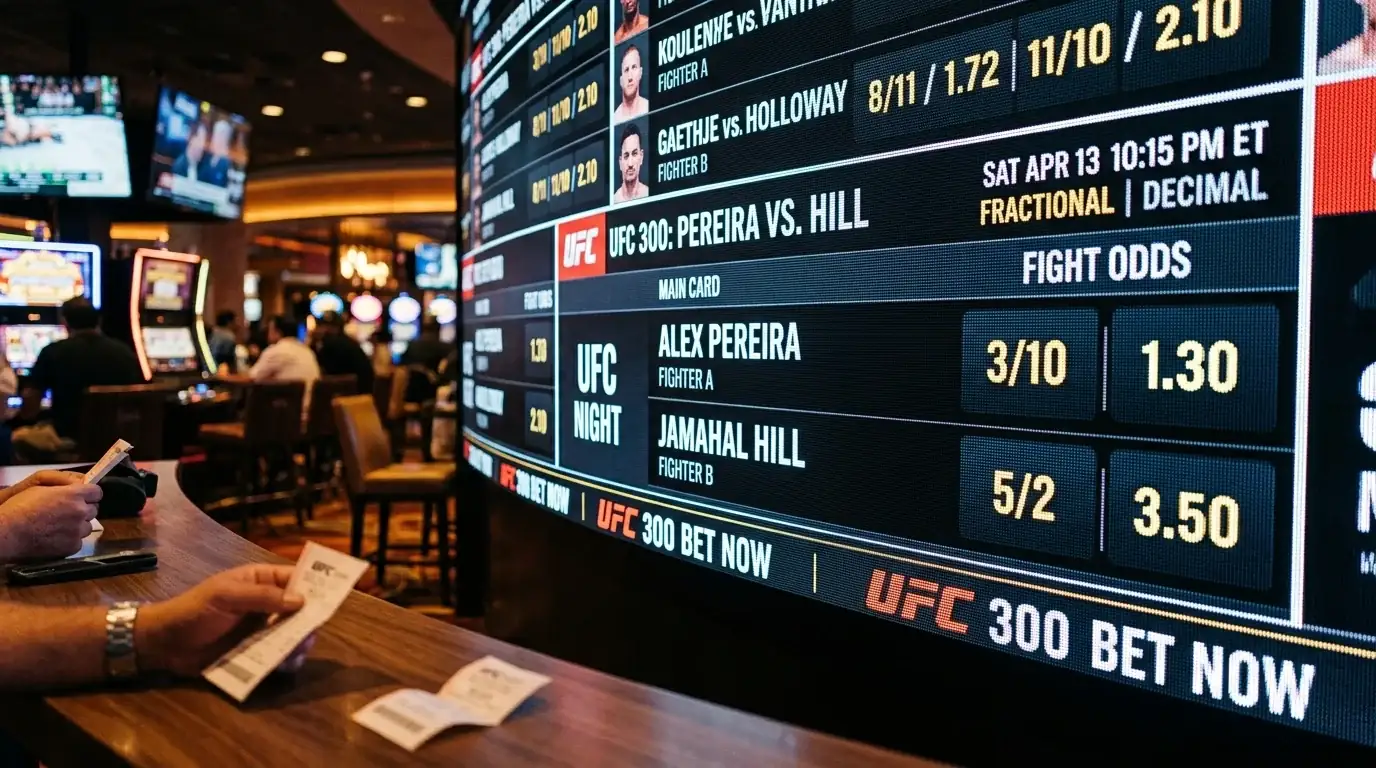
Start with implied probability. If a fighter is priced at 2.50 decimal, the market implies a 40% win chance. Your job is to determine whether that fighter wins more or less than 40% of the time in this specific matchup, against this specific opponent, under these specific conditions. If your analysis says 50%, you have a ten-percentage-point edge. If it says 35%, you’re looking at a bad bet even though you might like the fighter.
Underdogs at +200 or wider won 39% of their UFC bouts in 2024 — a striking figure against a historical average of 28%. The implied probability at +200 is 33.3%. If fighters in this price range are actually winning 39% of the time, there’s a systematic undervaluation happening. Not every underdog at that price is worth backing, but the aggregate data tells you that the market consistently underestimates fighters once they cross a certain price threshold.
I’ve found the most reliable value in three specific scenarios. The first is stylistic mismatches that the market underweights. Odds are heavily influenced by name recognition and recent results, but a grappler facing a striker with poor takedown defence often presents a wider gap between market price and actual probability than the headline odds suggest. The data on this is consistent: fighters with clear stylistic advantages in the dimension that matters most for a given matchup outperform their closing odds.
The second scenario is the returning fighter. When a competitor comes back from a long layoff, the market tends to anchor on their last performance. If they lost decisively, the odds overreact to the downside. If they won spectacularly, the market overreacts to the upside. In both cases, the actual probability sits closer to the fighter’s career baseline than to the outlier performance. Ring rust is a real factor, but it’s less predictive than the market treats it.
The third scenario involves fighters moving up or down in weight class. A fighter who performed well at lightweight but moves to welterweight faces different physical dynamics, yet the odds often price them based on their lightweight resume. The adjustment for weight-class transitions is one of the least efficient aspects of UFC pricing — in part because the sample size for any individual fighter in a new division is tiny, and bookmakers rely more heavily on name value than on projected physical matchup data.
None of these scenarios produce guaranteed outcomes. They produce edges — small, repeatable informational advantages that, bet after bet, card after card, compound into profit. Value betting isn’t about predicting individual fights correctly; it’s about making bets where the price exceeds the risk over a long sample.
There’s a psychological dimension to value betting that rarely gets discussed. Identifying value often means backing fighters you don’t necessarily expect to win. A bet at 3.50 on a fighter you assess as a 35% chance is a value bet — the implied probability is 28.6%, and you believe the true probability is six percentage points higher. But that fighter still loses nearly two out of three times. You have to be comfortable placing bets you expect to lose more often than they win, because the payout when they do win more than compensates. Most recreational bettors can’t stomach that. They want to bet on winners. Value bettors want to bet on prices.
Weight-Class Tendencies: Adjusting Strategy by Division
I lost a bet on a flyweight fight once because I applied my heavyweight heuristics to a division where they had no business being used. The fighters were both decision machines with 70%+ distance rates, and I’d taken the over/under at 1.5 rounds — a line I would have hammered in the heavyweight division but which was almost comically wrong for flyweight. That mistake taught me something fundamental: UFC isn’t one sport. It’s eight or nine different sports operating under the same brand, and each weight class has its own statistical personality.
At heavyweight, roughly 65% of bouts end early — KO/TKO is the dominant finish method, and decisions account for only about 28.6% of outcomes, the lowest in the promotion. The physics are simple: bigger fighters carry more power, absorb damage less gracefully, and fatigue faster. For bettors, this means method-of-victory and over/under markets behave very differently than in lighter classes. Backing a KO/TKO at heavyweight isn’t speculation; it’s alignment with the base rate.
The UFC’s overall finish rate dropped to 45% in 2024 — the worst in a decade, down from 52% just a year earlier. But that decline wasn’t distributed evenly across divisions. Heavier weight classes maintained higher finish rates while lighter divisions pushed the average down with longer, more technical bouts. The practical implication: a blanket approach to over/under betting across the entire card is a losing proposition. You need division-specific baselines.
Lightweight and featherweight occupy a middle ground — enough power for knockouts, enough cardio for three-round wars. These divisions produce the most unpredictable finishes, which means the odds on over/under lines are harder to beat. I tend to focus my prop betting in heavier and lighter divisions where the base rates are more extreme and therefore create wider gaps between market pricing and actual outcomes.
At bantamweight and flyweight, decisions dominate. These fighters are fast, durable, and technically refined. Knockouts happen but they’re the exception, not the expectation. If you’re looking for decision value, these divisions are where to find it — the “goes the distance” prop is priced against the casual bettor’s expectation of a finish, which is shaped more by UFC marketing than by divisional statistics.
Women’s divisions add another layer. The talent pool is shallower, which creates more mismatches on paper — but also more upsets in practice, because physical attributes and cardio often matter more than skill differentials when both fighters are operating at a lower technical ceiling. I’ve found women’s divisions to be slightly less efficient in pricing, which means more opportunities for bettors who do division-specific homework.
There’s a broader pattern worth noting here. In 2024, the UFC held 517 bouts across 42 events. Of those, 59 ended by KO, 87 by TKO, 84 by submission, and 281 by decision. Those aggregate numbers mask the divisional variation underneath. If you’d bet every over/under at 2.5 rounds the same way regardless of weight class, you’d have missed the signal that the heavier divisions were skewing under while the lighter divisions were skewing over. The aggregate truth and the divisional truth were telling different stories.
The strategic takeaway is simple but often ignored: before placing any UFC bet, check the base rates for the specific weight class. What percentage of fights in this division finish inside the distance? What’s the KO rate versus submission rate? How often do underdogs win? Those divisional baselines are your starting point. Everything else — matchup analysis, form, camp reports — adjusts from that baseline, not from zero.
How Line Shifts Signal Value Opportunities
Fight week is when UFC odds tell a story — if you know how to read it. Lines open days or even weeks before an event, and by the time the cage door closes, those numbers have often moved significantly. The direction, speed, and timing of that movement carry information that most casual bettors ignore entirely.
A line that moves gradually from -180 to -200 over five days typically reflects steady public money. The majority of recreational bettors back favourites, and as more casual wagers flow in during fight week, the favourite’s price shortens incrementally. This kind of drift is predictable and usually doesn’t signal new information — it signals popularity.
A line that jumps sharply in a short window — say, from -250 to -154 over a few hours — is a different animal. That kind of movement almost always indicates either significant sharp money (professional bettors loading up on one side) or material new information hitting the market. The Isaac Dulgarian fight on UFC Vegas 110 is the textbook cautionary example: the line shifted from -250 to -154 before the bout, a movement so extreme that it triggered integrity reviews and one sportsbook voided all bets on the fight. Not every sharp move means foul play, but moves of that magnitude in a short timeframe demand attention.
For a deeper examination of how odds movement works and what different patterns indicate, I’ve written a full breakdown of UFC betting line movement that covers steam moves, gradual drift, and the signals that separate routine adjustment from something worth investigating.
The practical application for your own betting is to track opening lines and compare them to closing prices. If you consistently bet on fighters whose lines are moving against you — getting longer after you’ve placed your bet — it suggests your selections align with the public side of the market, which is usually the less informed side. If your bets move in your favour after placement, you’re more likely identifying the same value that sharp bettors see.
Bankroll Management: Staking Plans That Survive Variance
The single most uncomfortable conversation in MMA betting is about money management, because it forces you to confront how small each individual bet should be relative to your total bankroll. I’ve seen sharp analysts with genuine edges go broke because they staked 15-20% of their bankroll on “can’t lose” main events. In UFC, there is no such thing as can’t lose. A lucky punch, a freak injury, a bad scorecard — the sport is structurally volatile, and your staking plan needs to reflect that reality.
The standard recommendation in professional sports betting is to risk 1-3% of your bankroll on any single wager. For UFC specifically, I lean toward the lower end of that range — 1-2% — because MMA outcomes are more volatile than team sports. A single competitor determines the result, one mistake can end a fight, and the sample of fights per card is small enough that variance hits harder per event than it does across a weekend of Premier League football.
UFC GGR has grown at an estimated annual rate exceeding 18% over the past five years, outpacing almost every other major sport in percentage terms. That growth means more money in the market, more liquidity, and in theory, more efficient pricing. Efficient markets are harder to beat, which makes bankroll preservation even more critical. Your edge, if you have one, is likely small in percentage terms — perhaps 3-5% expected return on qualifying bets. A staking plan that risks too much per bet can erase that edge through variance long before the maths has a chance to play out.
I use a flat-stake approach: the same pound amount on every qualifying bet, recalculated monthly based on my current bankroll. Some bettors prefer the Kelly Criterion, which adjusts stake size based on the perceived edge on each bet. Kelly is mathematically optimal in theory, but in practice it requires accurate probability estimates — and overconfidence in your estimates (a near-universal human flaw) leads to overstaking. A flat approach with disciplined bet selection is harder to ruin.
The other bankroll discipline that matters is session management. UFC cards run for three to five hours. By the co-main event, you’ve been watching fights, tracking your open bets, and experiencing the emotional highs and lows of wins and losses for hours. This is when tilt betting happens — chasing losses on the main event or pressing winnings with an impulsive live bet. I have a hard rule: my bets for the card are locked in before the first prelim airs. If I spot live value, I can act on it, but the stakes are pre-determined and the decision framework is set before the emotional rollercoaster begins.
Five Analytical Mistakes That Erode Your UFC Betting Edge
After nine years of analysing UFC odds full-time, I can identify five analytical errors that account for the majority of money lost by otherwise intelligent MMA bettors. These aren’t beginner mistakes — they’re traps that experienced punters fall into because they feel like smart analysis rather than the cognitive shortcuts they actually are.
The first is recency bias masquerading as form analysis. A fighter who scored a spectacular knockout in their last bout gets priced as a knockout threat in their next fight, even if their career KO rate is modest and the previous finish was an outlier. Genuine form analysis looks at a fighter’s last eight to ten performances, not their highlight reel. One spectacular result is noise. A consistent pattern is signal.
The second is treating all divisions identically. I’ve covered this above, but it bears repeating as a distinct error category: the finish rate at heavyweight (65% early stoppages) versus flyweight (decision-heavy) means that betting strategies, prop selections, and over/under assessments must be calibrated per division. A bettor who doesn’t adjust for weight class is essentially bringing a road map of London to navigate Edinburgh — the format is familiar, but the terrain is completely different.
The third mistake is overvaluing name recognition in parlay construction. Parlaying three household-name favourites feels safe because each individual leg seems likely. But the combined probability drops rapidly — three -200 favourites in a parlay have a combined implied win probability of just 29.6%, meaning the bet fails more than 70% of the time. Yet recreational bettors treat these as “safe accas” because each name is individually reassuring.
The fourth is ignoring the overround when comparing odds across bookmakers. Two pounds difference in potential return might seem trivial on a single bet, but across 200 bets per year, the cumulative impact of betting at inefficient prices versus sharp prices can be the difference between a winning year and a losing one. Line shopping isn’t glamorous, but it’s the highest-return activity per minute of effort in all of sports betting.
The fifth, and the one I personally struggled with longest, is confusing accuracy with profitability. Picking winners at 60% feels excellent. But if those winners are all heavy favourites priced at 1.30 or shorter, your return on each correct pick is tiny, and the 40% of losses hit harder. Profitability requires picking winners at a rate that exceeds the break-even rate implied by the odds you’re getting. A 55% winner-picking rate at average odds of 2.00 is more profitable than a 70% rate at average odds of 1.20. The maths doesn’t care about your accuracy — it cares about your expected value per bet.
See also: find the right platform with our UFC betting sites UK comparison.
Questions About UFC Betting Strategy
Does betting on UFC favourites guarantee long-term profit?
No. Favourites won 72% of UFC bouts in 2024, but the odds on those favourites were priced to reflect that win rate. Blindly backing every favourite produces negative expected returns because the bookmaker’s margin ensures you pay more than the true probability warrants. Profitable favourite betting requires selectivity — identifying specific favourites whose actual win probability exceeds the implied probability in the odds.
How do weigh-in results affect UFC betting lines?
Weigh-ins can shift lines significantly, particularly when a fighter misses weight or looks physically compromised. A dramatic weight cut that leaves a fighter gaunt at the scales often triggers a line movement of 10-20 points as sharp bettors adjust their assessments. The visual weigh-in and the official scale results are two distinct information events, and both can move the market independently.
What is the single most overlooked statistic in MMA betting?
Division-specific finish rates. Most bettors apply a generic sense of how UFC fights end without adjusting for the massive differences between weight classes. Heavyweight bouts finish early roughly 65% of the time, while lighter divisions go to decision far more often. Every prop bet, every over/under, and every method-of-victory wager should start with the base rate for the specific division involved.
How many fights should I bet on per UFC card?
There is no fixed number — the answer depends on how many qualifying value opportunities you identify. On a typical 12-fight card, I find genuine value in two to four bouts. Betting more fights doesn’t increase your expected profit; it increases your variance and dilutes your edge by including bets where the value assessment was marginal. Quality of selection always beats quantity.
Written by the editors at bet on ufc Fights.