UFC Round Betting Explained: Over/Under Rounds, Exact Round, and Group Round Markets
 Available in US
- Why Round Betting Offers Better Odds Than a Simple Moneyline
- Over/Under Rounds: The Most Popular UFC Round Market
- Exact Round Betting: High Risk, High Reward
- Group Round Betting: A Middle Ground Between Moneyline and Exact Round
- Three-Round vs Five-Round Fights: How Title Bouts Change the Maths
- Timing Your Read: When Round Bets Beat the Moneyline
Why Round Betting Offers Better Odds Than a Simple Moneyline
A few years back, I had a fight dead to rights — I knew the favourite would win, and the matchup screamed early finish. The moneyline was -350, requiring me to risk 350 to win 100. Instead, I took the under 1.5 rounds at -110 and banked nearly three times the profit I would have made on the moneyline when the fight ended in the first. That is the appeal of round betting in a sentence: the same read, better price.
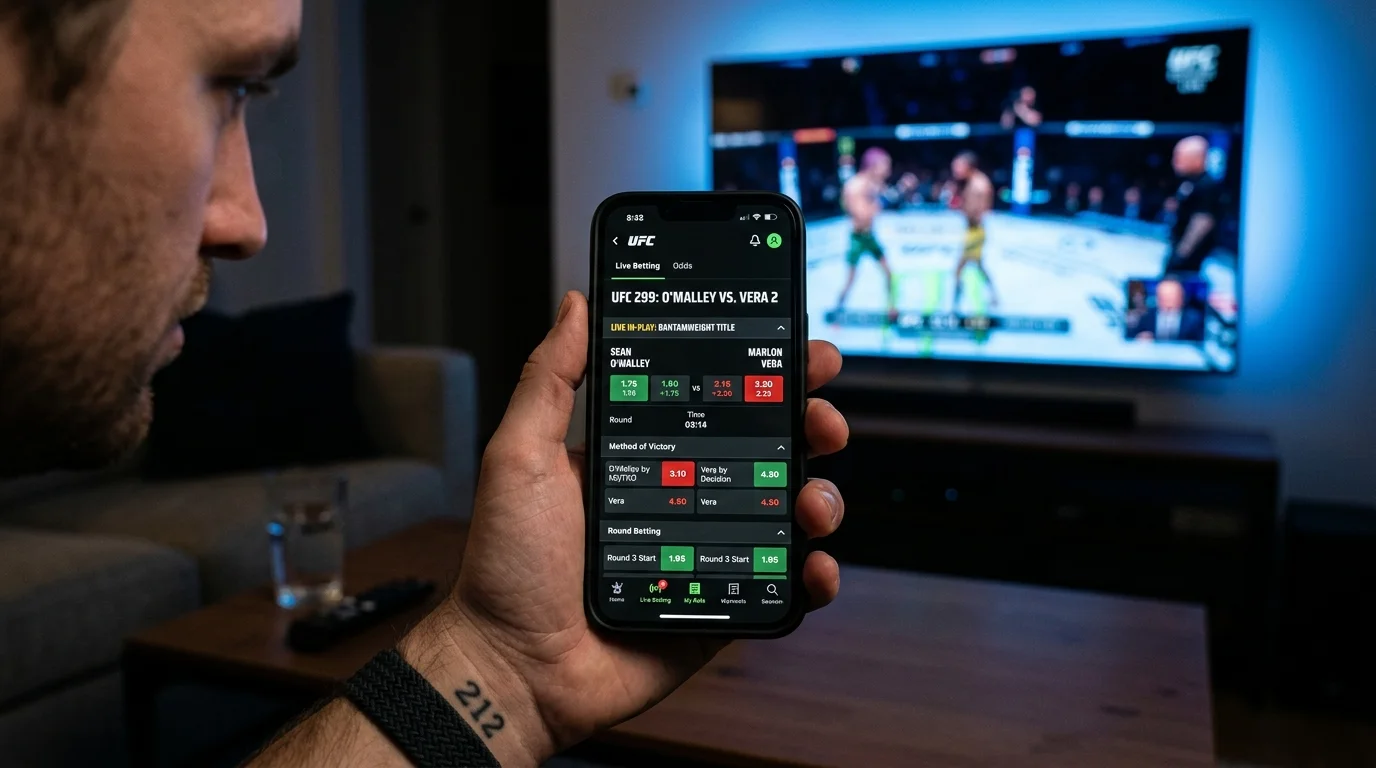
Round markets let you express a more specific opinion about a fight than the moneyline does. Rather than simply picking a winner, you are predicting the fight’s duration — and the more precise your prediction, the higher the odds. Roughly 41% of men’s UFC bouts finish inside 2.5 rounds, which tells you that the fight-length market is not some obscure prop; it applies to nearly half of all contests. If you want to see how round-by-round timing works in real-time wagering, the live UFC betting guide covers the in-play dimension.
See also: bet on ufc fights for round-by-round and outright markets.
Over/Under Rounds: The Most Popular UFC Round Market
Over/under rounds is to UFC what over/under goals is to football — the foundational totals market. The sportsbook sets a line (most commonly 1.5 or 2.5 rounds in a three-round fight, or 2.5 or 3.5 in a five-round championship bout), and you bet whether the fight ends before or after that mark.
The half-round eliminates pushes. A fight ending by stoppage at 2:30 of the second round is “under 2.5.” A fight ending at 0:01 of the third round is “over 2.5.” The precision matters, because round-betting outcomes can turn on seconds.
In three-round fights, the 1.5-round line is the most volatile. An under 1.5 bet requires a finish in round one — a genuine rarity outside heavyweight. The 2.5-round line is the bread-and-butter market: under 2.5 means the fight ends in round one or two; over 2.5 means it reaches the third round or goes to decision. With the UFC’s overall finish rate at 45% in 2024, the over 2.5 rounds bet has been hitting at elevated rates, particularly in lighter weight divisions where finishes are less common.
For five-round championship or main-event fights, the standard line shifts to 2.5 or 3.5 rounds. These fights have more room to breathe, and the dynamics change: fighters pace themselves differently over five rounds, and comeback victories in the later rounds are more frequent. I generally find better value in the 2.5-round line for five-round fights, because the market tends to overestimate early finishes in high-profile main events where both fighters are cautious about making mistakes.
Exact Round Betting: High Risk, High Reward
If over/under is the sensible sedan, exact round betting is the motorbike — thrilling when it works, painful when it does not. This market asks you to predict the specific round in which the fight ends. The odds are correspondingly generous: picking a round-one finish in a three-round fight might pay 6/1 or higher, depending on the matchup.
The appeal is obvious. The challenge is that even when you correctly identify a fight as likely to end early, pinpointing the exact round adds a layer of variance that is almost impossible to model with precision. A fight that feels like a first-round knockout can easily spill into the second because one fighter survives the initial onslaught and the pace resets.
I use exact round bets sparingly and only in specific situations: when a heavy-handed striker faces a fighter with a documented glass chin, when the stylistic matchup strongly favours a first-round grappling exchange leading to submission, or when a fighter has a pattern of starting slowly and fading late (making later rounds more predictable). Outside those narrow windows, the variance makes exact round betting a poor use of bankroll for anyone trying to grind a long-term edge.
One tactical note: some sportsbooks offer “round group” betting as a middle ground (covered next), which captures the appeal of round specificity without demanding pinpoint accuracy. If you are tempted by exact round bets, check whether the group market gives you a better risk-reward profile first.
Group Round Betting: A Middle Ground Between Moneyline and Exact Round
Group round betting splits the fight into segments — typically rounds 1-2, rounds 3-4, round 5, or decision — and asks you which segment contains the finish. It is less precise than exact round betting but far more precise than the moneyline, and the odds reflect that middle position.
I find group round markets most useful in five-round fights, where the fight has enough duration to create meaningfully different segments. A main event between a fast starter and a slow-building cardio fighter creates a natural split: rounds 1-2 favour the fast starter’s power, rounds 3-5 favour the cardio fighter’s endurance. Betting “finish in rounds 1-2” by fighter A or “finish in rounds 3-5” by fighter B lets you express a specific tactical read that the moneyline cannot capture.
In three-round fights, the group market is less interesting because there are only three rounds to split. But in five-round championship bouts, group rounds are one of my favourite markets. They reward tactical thinking about fight dynamics without demanding the surgical precision of exact round picks.
Three-Round vs Five-Round Fights: How Title Bouts Change the Maths
The difference between a three-round fight and a five-round fight is not just two extra rounds. It changes everything about the pacing, the strategy, and the probability distribution of when a finish occurs.
In a three-round fight, fighters often push a faster pace because they know the window is short. If a fight survives the first round without a clear advantage being established, the probability of a decision increases sharply. At heavyweight, where 65% of bouts end early, a three-round fight that reaches the second round has already beaten the base-rate expectation, and the decision probability climbs.
Five-round fights distribute finishes more evenly across the duration. Championship fighters pace themselves, knowing they have 25 minutes rather than 15. Late stoppages in rounds four and five are more common than in any three-round fight, because accumulated damage, cardio depletion, and mental fatigue compound over the additional ten minutes. This creates value in “late finish” props and group round bets targeting rounds 3-5.
The practical implication for round bettors: in three-round fights, the under 1.5 is a high-conviction, high-risk play that works best in heavyweight and light heavyweight. In five-round fights, the market’s complexity creates more niches — early finish, late finish, distance — and consequently more opportunities to find a mispriced outcome. I allocate more of my round-betting bankroll to five-round fights for exactly this reason.
Timing Your Read: When Round Bets Beat the Moneyline
Round betting beats the moneyline when you have a strong opinion not just on who wins but on the fight’s duration. If you think a fighter wins and you think the fight is short, over/under or group rounds will almost always offer a better return than the moneyline for the same level of confidence. If you only have a read on the winner but no view on duration, the moneyline is the cleaner bet.
See also: check the legal position with our is UFC betting legal in the UK guide.
The mistake I see most often is bettors adding round specificity to increase their payout without actually having a round-specific thesis. “I think fighter A wins in round two” sounds more sophisticated than “I think fighter A wins,” but if your analysis does not support the round-two call, you are just adding noise to your bet for the sake of bigger odds. Bigger odds are meaningless if the additional specificity is not grounded in something real.
What does over/under 2.5 rounds mean in a UFC fight?
Over 2.5 rounds means the fight continues past the halfway point of round three — either reaching a decision or being stopped in the second half of round three or later. Under 2.5 means the fight ends by stoppage during round one, round two, or the first half of round three. The half-round line eliminates the possibility of a push.
How do exact round bets pay out in UFC title fights with five rounds?
Exact round bets in five-round fights typically offer higher odds than in three-round bouts because there are more possible outcomes. Each of the five rounds plus the decision option creates six possible results, spreading the probability thinner. Payouts for a correct exact-round pick in a five-round fight can range from 5/1 to 15/1 or higher depending on the matchup and the specific round selected.
Written by the editors at bet on ufc Fights.