UFC Scorecard Betting: How Judges Score Fights and What It Means for Your Wagers
 Available in US
- The Third Fighter in the Cage — and Why Bettors Ignore Them
- The 10-Point Must System: How UFC Rounds Are Scored
- What Judges Prioritise: Effective Striking, Grappling, Aggression, and Control
- Why Controversial Decisions Happen — and How to Bet Around Them
- Scoring Trends Across Weight Classes and How They Affect Props
- Turning Scorecard Knowledge Into Betting Edge
The Third Fighter in the Cage — and Why Bettors Ignore Them
I once lost a bet I was sure I had won. My fighter controlled three rounds, landed more strikes, dictated the pace — and lost a split decision because two judges valued top control and cage pressing more than output. That night taught me something that fundamentally changed how I approach UFC betting: the fighter you think won and the fighter the judges score as winning are not always the same person. If your decision-related bets do not account for how judges actually score, you are betting on a version of the sport that does not exist.
In 2024, 281 of 517 UFC bouts went to the scorecards — more than half the entire schedule. That 54% decision rate means the judging system touches the outcome of most fights on any given card. The finish rate dropped to 45%, its lowest point in a decade, and the trend shows no sign of reversing. For bettors, understanding the scoring criteria is no longer optional. It is the foundation of every decision prop, every “fight goes the distance” bet, and every method-of-victory market that includes a decision outcome.
See also: bet on ufc fights for decision and points-based markets.
The 10-Point Must System: How UFC Rounds Are Scored
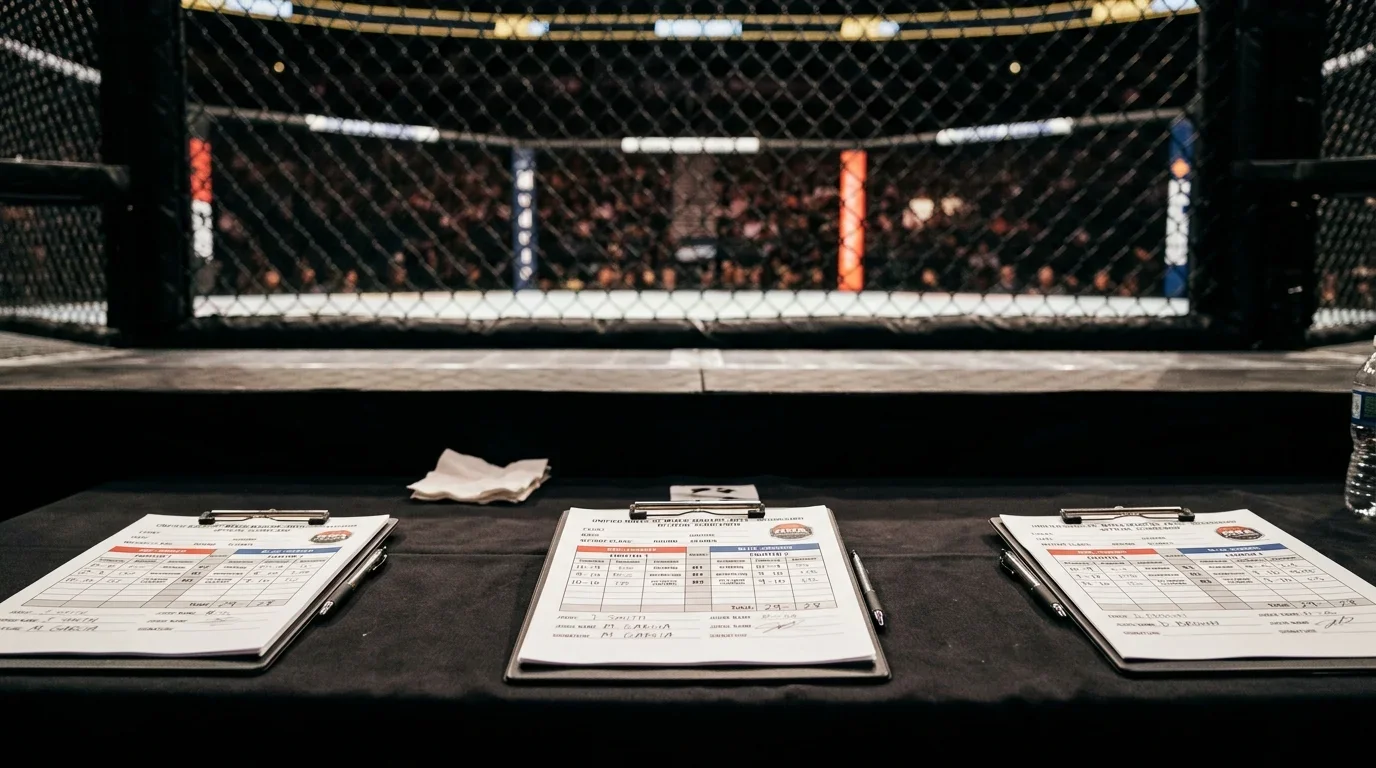
Every UFC fight is scored using the 10-point must system, borrowed from boxing and adapted for MMA. The winner of a round receives 10 points; the loser receives 9 or fewer. A 10-9 round is the standard outcome for a competitive round where one fighter edges the other. A 10-8 round indicates dominance — one fighter significantly outperformed the other through knockdowns, sustained offence, or total control. A 10-7 round is exceptionally rare and reserved for one-sided beatdowns that the referee probably should have stopped.
Three judges score independently from cageside positions. Their scores are not shared with each other or with the fighters during the bout. After the final round, the judges’ scorecards are collected and tabulated. If all three agree, it is a unanimous decision. If two agree and one dissents, it is a split decision. A majority decision occurs when two judges agree on the winner and the third scores a draw. Understanding these distinctions matters because some sportsbooks offer separate props on the type of decision — and the pricing on split decision props is often generous because the public underestimates how frequently judges disagree.
What Judges Prioritise: Effective Striking, Grappling, Aggression, and Control
The Unified Rules of MMA establish a hierarchy of scoring criteria. Effective striking and effective grappling are evaluated first and carry the most weight. Aggression is a secondary criterion used to break ties when striking and grappling are even. Octagon control — generalship, positioning, dictating where the fight takes place — is the tertiary criterion, used only when all other factors are equal.
In practice, this hierarchy creates predictable patterns that bettors can exploit. Judges tend to reward damage over volume. Ten hard shots that visibly hurt an opponent will outscore thirty light jabs that land but do not affect the fight. Takedowns followed by meaningful ground offence score higher than takedowns where the fighter simply holds position without advancing. And the fighter who is moving forward and pressing the action gets the nod in close rounds more often than the one circling and counter-striking, even if the counter-striker lands the cleaner shots.
I have found the most consistent edge in decision props by mapping the judging criteria onto the specific fighters’ styles. A pressure fighter who walks forward and throws heavy shots with visible impact will score well on effective striking and aggression simultaneously. A counter-striker who picks shots from the outside may land at a higher percentage but score lower on the aggression criterion in close rounds. When I am evaluating a “fight goes to decision” prop combined with a moneyline, the judging criteria tell me which fighter benefits from a decision outcome — and the market does not always price that advantage correctly.
Why Controversial Decisions Happen — and How to Bet Around Them
Controversial decisions in UFC are not random. They follow patterns. Fights that involve a grappler controlling position without finishing versus a striker landing from the bottom tend to produce split decisions because judges disagree on whether control or damage is more valuable. Fights where one fighter wins the first two rounds clearly and the other rallies in rounds three through five produce splits because the margin is narrow and one swing round determines the outcome.
For bettors, the practical implication is this: when a matchup features two fighters with contrasting styles that historically produce controversial scoring, the split decision prop becomes attractive. The market typically prices split decisions at long odds because they are individually unlikely — any single fight has roughly a 15-20% chance of producing a split among fights that go to decision. But in specific matchups where the style clash almost guarantees disagreement among judges, that probability climbs to 25-30%, and the odds rarely adjust to reflect it.
I track split decision frequency by fighter as part of my pre-fight research. Fighters who have been involved in multiple split decisions tend to keep producing them, because their style creates ambiguity in the scoring criteria. That historical pattern is one of the most reliable edges I have found in the niche prop market around decision types.
Scoring Trends Across Weight Classes and How They Affect Props
Judging patterns vary by weight class in ways that mirror the divisional finish rates. Heavyweight and light heavyweight decisions are rarer but tend to be more decisive when they occur — judges agree more often because the rounds are usually clearer. One fighter typically dominates through power or wrestling control, and the scoring reflects that dominance with wider margins. Split decisions at heavyweight are genuinely uncommon.
At lighter weights — bantamweight, featherweight, flyweight — decisions are frequent and close. The pace is higher, the damage differential between fighters is smaller, and the rounds are harder to separate. This is where split decisions cluster, where judging controversy lives, and where the “fight goes the distance” prop offers the most consistent value. A method-of-victory breakdown by division provides the finish-rate context, but the scoring dynamics within the decision category add another exploitable layer.
Women’s divisions follow a similar pattern. The strawweight and flyweight women’s divisions produce high decision rates with frequent split decisions, because the fights are technically competitive and the damage differential is often marginal. If you are betting decision props on women’s fights, expect disagreement among judges more often than in the equivalent men’s weights.
Turning Scorecard Knowledge Into Betting Edge
The scorecard system is the most overlooked analytical tool in UFC betting. Most bettors think about who wins and how the fight ends. Fewer think about the mechanics of how a winner is determined when the fight reaches the scorecards — and fewer still build those mechanics into their pricing models. That neglect creates value for anyone willing to study the judging criteria, track individual judges’ tendencies, and identify matchups where the scoring system systematically favours one fighter over the other.
See also: scorecards matter most in method of victory betting — KO, sub or decision.
My process for decision-related bets starts with three questions. Does this fight profile as likely to reach the scorecards? If it does, which fighter benefits from the judging criteria given the stylistic matchup? And is the market pricing that advantage into the decision-method prop? When the answer to the third question is no — when the market undervalues a fighter’s scoring advantage in a fight likely to go the distance — I have a bet worth taking.
How do UFC judges score a round?
UFC judges use the 10-point must system. The round winner receives 10 points and the loser receives 9 or fewer. A 10-9 score indicates a competitive round with a clear winner. A 10-8 indicates dominance through knockdowns, sustained offence, or total control. Judges evaluate effective striking and grappling first, then aggression, then octagon control as tiebreakers.
What is the difference between a split decision and a unanimous decision in UFC?
A unanimous decision means all three judges scored the fight for the same fighter. A split decision means two judges scored for one fighter and the third scored for the opponent. Split decisions occur when the fight is close and the judges disagree on which fighter won the swing rounds. A majority decision means two judges agree on the winner while the third scored a draw.
Created by the ”bet on ufc Fights” editorial team.