UFC Betting Glossary: Every Term a UK Punter Needs to Know
 Available in US
- The Language Barrier That Costs Bettors Money
- Core Bet Types: The Markets You Will See on Every UFC Card
- Odds Formats: Fractional, Decimal, and American Explained
- UFC-Specific Terminology: MMA Language That Appears on Bet Slips
- Sportsbook-Specific Terms: Understanding Your Bet Slip
- Advanced Terms: Language for Experienced UFC Bettors
- Keeping the Glossary in Your Back Pocket
The Language Barrier That Costs Bettors Money
My first month of UFC betting, I placed a bet on what I thought was a simple “over 2.5 rounds” market. What I had actually selected was “over 2.5 total significant strikes in round one” — a completely different prop that lost before the round was halfway done. The terminology looked similar enough on the bet slip that I did not catch the difference until my money was gone. Betting has its own dialect, MMA adds another layer of specialised vocabulary, and the intersection of the two creates a minefield for anyone who has not learned the language.
Across 517 fights and 42 events in 2024, UK sportsbooks offered hundreds of distinct markets per card. Each market uses specific terminology that, if misunderstood, can lead to a bet that does not match your intention. This glossary covers the terms you will encounter most frequently, organised by how they actually appear on your bet slip rather than in alphabetical order that nobody reads from top to bottom. If you are placing your first UFC wagers and want a practical walkthrough of the process, the beginner’s guide covers the mechanics step by step.
See also: bet on ufc fights for definitions and key betting concepts.
Core Bet Types: The Markets You Will See on Every UFC Card
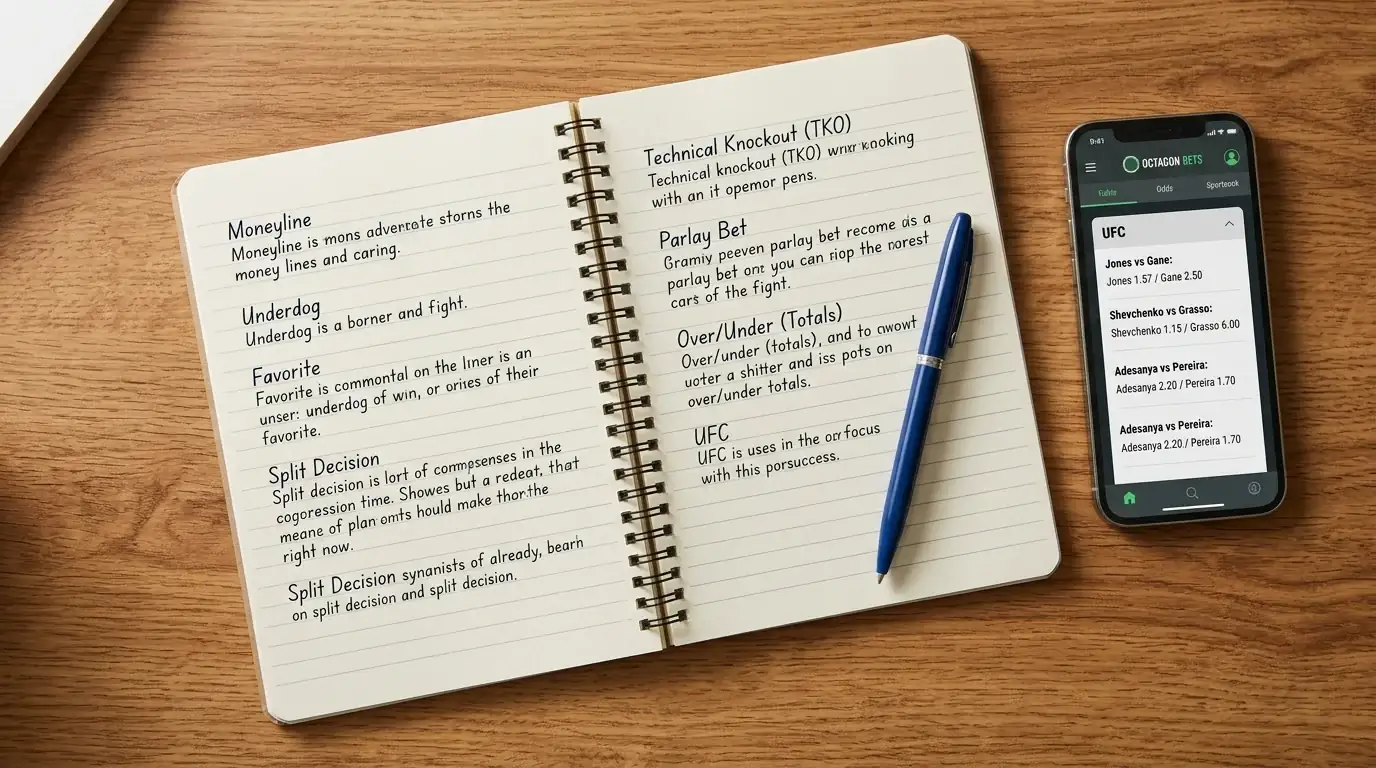
Moneyline. The most fundamental bet in UFC: pick which fighter wins the bout. No conditions on how or when — just the winner. In UK sportsbooks, moneyline odds are typically displayed in fractional format (4/1, 1/3) or decimal (5.00, 1.33). The moneyline is where most bettors start and where the market is most efficient, because it attracts the highest volume.
Method of victory. A bet on how the fight ends: KO/TKO, submission, or decision. Some sportsbooks split decision into unanimous, split, and majority. This market is less efficient than the moneyline because fewer bettors study the method-specific data. When favourites won roughly 72% of UFC bouts in 2024, the method market was where the real value often hid — not in who wins, but in how they win.
Over/under rounds. A bet on the fight’s duration. The sportsbook sets a line — most commonly 1.5 or 2.5 rounds for a three-round fight — and you bet whether the fight ends before (under) or after (over) that mark. The half-round eliminates pushes. A fight stopped at 2:30 of round two is under 2.5; a fight that reaches 0:01 of round three is over 2.5.
Fight goes the distance. A yes/no market on whether the fight reaches the judges’ scorecards without a stoppage. “Yes” means no finish occurs. This market is the simplest way to bet on fight duration without specifying a round, and it tends to be underpriced on the “yes” side because the public gravitates toward finishes.
Odds Formats: Fractional, Decimal, and American Explained
Walk into a UK betting shop and you will see fractional odds. Open most online sportsbooks and you will see decimal as the default. Follow American MMA media and every price is in moneyline format. All three express the same underlying probability — they just display it differently.
Fractional odds (4/1, 1/3). The first number is your profit; the second is your stake. At 4/1, a one-pound bet returns four pounds in profit plus your one-pound stake. At 1/3, you need to stake three pounds to profit one pound. Fractions below 1/1 indicate a favourite; above 1/1 indicate an underdog. The implied probability of 1/3 is 75%; the implied probability of 4/1 is 20%.
Decimal odds (5.00, 1.33). Multiply your stake by the decimal to get your total return including the stake. A one-pound bet at 5.00 returns five pounds total (four pounds profit). A one-pound bet at 1.33 returns 1.33 pounds total (0.33 pounds profit). Decimal odds make it easier to compare prices across sportsbooks because the calculation is straightforward.
American odds (+400, -300). Positive numbers show how much profit a 100-unit stake returns; negative numbers show how much you need to stake to profit 100 units. +400 means a 100-pound bet profits 400 pounds. -300 means you must stake 300 pounds to profit 100 pounds. UK sportsbooks rarely default to American format, but UFC content from US-based media uses it exclusively.
I keep my sportsbook set to decimal because it makes quick comparisons easiest. But every serious bettor should be fluent in all three formats, because the best price on a fight might appear on a sportsbook that displays a different format from the one you prefer.
UFC-Specific Terminology: MMA Language That Appears on Bet Slips
TKO vs KO. A KO (knockout) is when a fighter is rendered unconscious or unable to continue by strikes. A TKO (technical knockout) is a referee stoppage when a fighter is conscious but not intelligently defending. For betting purposes, most sportsbooks group both as a single “KO/TKO” outcome.
Submission. A fighter forces their opponent to “tap out” — signal surrender — through a choke, joint lock, or other grappling technique. The historical submission rate across UFC history is approximately 20% of all finishes.
Decision (UD, SD, MD). When a fight goes the scheduled distance, three judges determine the winner using the 10-point must system. UD is unanimous decision (all three judges agree). SD is split decision (two judges favour one fighter, one favours the other). MD is majority decision (two judges favour one fighter, one scores a draw).
No contest (NC). The fight is declared void, typically due to an accidental foul that prevents the bout from continuing. Bets are usually refunded on a no contest, though terms vary by operator.
Weight class. UFC fighters compete in divisions defined by maximum weight: flyweight (125 lbs), bantamweight (135 lbs), featherweight (145 lbs), lightweight (155 lbs), welterweight (170 lbs), middleweight (185 lbs), light heavyweight (205 lbs), and heavyweight (265 lbs). Women’s divisions include strawweight (115 lbs), flyweight (125 lbs), bantamweight (135 lbs), and featherweight (145 lbs). The division affects finish rates, fight pace, and decision frequency — all of which feed into prop-market pricing.
Sportsbook-Specific Terms: Understanding Your Bet Slip
Accumulator (acca). A single bet combining multiple selections. All legs must win for the bet to pay out. In UFC, a common acca combines moneyline picks from several fights on the same card. The risk compounds: on a five-leg acca with each leg at 60% probability, your overall win probability is just 7.8%.
Bet builder / same-game parlay. Combines multiple selections from a single fight into one bet. You might combine “Fighter A wins” with “over 2.5 rounds” and “by decision.” The bookmaker adjusts the combined odds for correlation between the legs.
Each way. A bet type common in horse racing that has no meaningful application in UFC. If you see an each-way option on a UFC market, you almost certainly want “win only.” There is no second place in a fight.
Cash out. The option to settle your bet before the fight concludes, taking a profit or cutting a loss at the current offered price. Available on live bets and sometimes on pre-fight bets once the event begins. The cash-out price always includes a margin for the bookmaker, so you are accepting a discount on the full potential payout.
Void / push. When a bet is cancelled and your stake returned. In UFC, this typically happens when a fight is cancelled, a fighter is replaced, or a no contest is declared. Half-round lines (1.5, 2.5) eliminate pushes on round-total bets.
Stake not returned (SNR). A term applied to free bets meaning that if your free bet wins, you receive the profit but not the original stake amount. A 10-pound free bet at 2/1 returns 20 pounds, not 30.
Advanced Terms: Language for Experienced UFC Bettors
Implied probability. The probability of an outcome as suggested by the odds, before removing the bookmaker’s margin. Calculated as 1 divided by the decimal odds. Odds of 2.50 imply a 40% probability. Comparing your own probability estimate to the implied probability is the fundamental method for identifying value.
Overround (vig, juice). The bookmaker’s built-in margin. If a two-outcome market has implied probabilities that sum to 105%, the overround is 5%. UFC moneyline markets typically carry 5-8% overround; prop markets can run higher. The overround is the cost of betting — the tax you pay for accessing the market.
Steam move. A rapid, large shift in the odds caused by heavy betting from sharp (professional) accounts. When a UFC line moves sharply in one direction within minutes, it usually indicates that respected money has entered the market on that side. Tracking steam moves before a fight can indicate where the sharpest bettors see value.
Closing line value (CLV). The difference between the odds at which you placed your bet and the odds at which the market closed before the fight. Consistently getting better odds than the closing line is one of the strongest indicators of long-term betting profitability. If you back a fighter at 2.50 and the line closes at 2.20, you captured positive CLV.
Expected value (EV). The average profit or loss per bet if the same bet were placed infinitely many times. Calculated as (probability of winning multiplied by profit) minus (probability of losing multiplied by stake). Positive EV means the bet is profitable long-term; negative EV means the bookmaker has the edge. Every serious bettor’s goal is to make only positive-EV bets.
Keeping the Glossary in Your Back Pocket
Terminology is not trivia — it is the interface between your analysis and your money. Every misunderstood term is a potential mislaid bet, and in a sport where the margins between profitable and unprofitable betting are thin, precision with language matters as much as precision with numbers. Bookmark this page, revisit it when a new term appears on your bet slip, and never place a bet on a market you cannot define in plain English. The UFC calendar runs nearly every week in 2026, and each card presents dozens of markets using the vocabulary above. Understanding them is the minimum entry requirement for putting your money to work.
See also: trade your positions with more control on UFC betting exchanges.
What does moneyline mean in UFC betting?
The moneyline is a bet on which fighter wins the bout, with no conditions on how or when the victory occurs. It is the simplest UFC bet type. Odds are displayed in fractional, decimal, or American format depending on the sportsbook, and the payout is determined by the odds at the time you place the bet.
What is the difference between a TKO and a KO in UFC?
A KO occurs when a fighter is rendered unconscious or unable to continue by strikes. A TKO is a referee stoppage when a fighter is still conscious but not intelligently defending themselves. For betting purposes, most UK sportsbooks group both outcomes together as KO/TKO in method-of-victory markets.
What does implied probability mean in betting odds?
Implied probability is the likelihood of an outcome as suggested by the betting odds, calculated as 1 divided by the decimal odds. If a fighter is priced at 2.50, the implied probability is 40%. Comparing your own probability estimate to the implied probability is the fundamental method for identifying whether a bet offers value.
Written by the editors at bet on ufc Fights.