UFC Cage Size and Betting: How the Octagon Dimensions Affect Fight Outcomes
 Available in US
Two Cages, Two Different Sports — and the Odds Rarely Adjust
I missed this edge for my first four years of UFC betting. It was not until I saw the same fighter — a pressure wrestler with heavy hands — dominate in the small cage and struggle in the large one three months later that I started tracking cage size as a variable. The data confirmed what that anecdote suggested: the UFC uses two different Octagon sizes, the size materially affects fight outcomes, and the betting market barely acknowledges the difference.
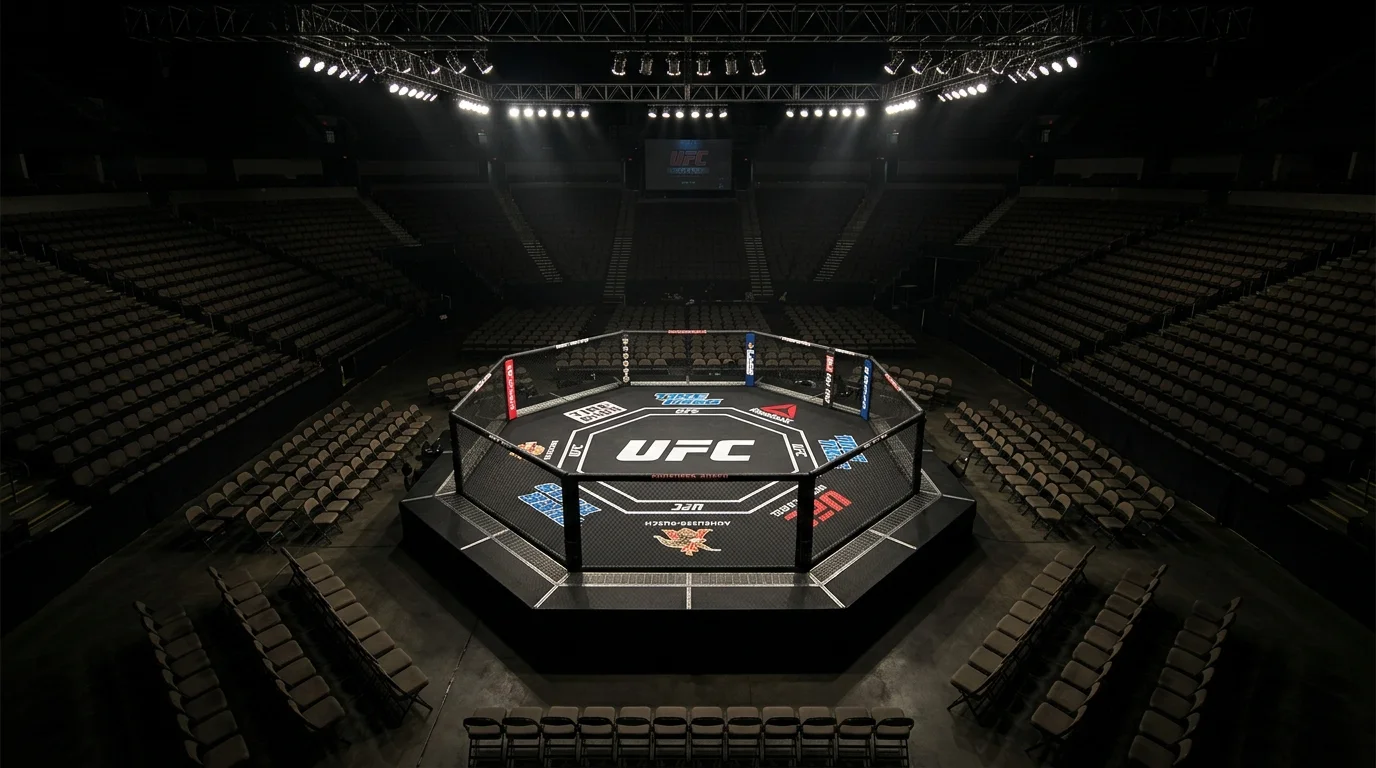
The UFC’s standard Octagon is 30 feet across. The smaller version, used at the UFC Apex and certain international venues, is 25 feet. That five-foot difference shrinks the total floor area by roughly 30%. For fighters, the difference in feel is enormous. For bettors, it is an exploitable blind spot.
See also: bet on ufc fights for venue and cage-specific analysis.
The Small Cage: Pressure Fighters’ Paradise
In the 25-foot cage, there is nowhere to hide. A retreating fighter runs out of space faster, gets backed against the fence sooner, and stays in the pocket longer. Every stylistic advantage that depends on controlling distance — long jabs, movement-based defence, counter-striking from the outside — is compressed.
Pressure fighters and wrestlers benefit the most from the small cage. A wrestler who cuts the cage and drives for takedowns against the fence has 30% less space to cover. A pressure striker who walks opponents down has fewer angles to be circled away from. The fight becomes more congested, more physical, and more likely to involve clinch work and grappling — all of which favour fighters whose game plans depend on closing distance.
The finish rate in the small cage has historically been higher than in the large cage, because the compressed space leads to more engagement and fewer periods of tentative range-finding. For over/under rounds bets, the small cage pushes the probability distribution toward earlier finishes. I apply a small-cage modifier to my under-rounds probability for every fight at the Apex or other small-cage venues — typically a 3-5% adjustment toward the under.
The Large Cage: Movers, Counter-Strikers, and the Distance Game
The 30-foot Octagon gives movement-based fighters room to operate. Counter-strikers who need space to set up their shots — lateral movement, angle changes, pulling back from exchanges — perform better when there is more floor to use. Fighters with strong footwork and ring generalship can maintain distance, dictate range, and avoid the fence for longer stretches.
The large cage also tends to produce longer fights. More space means more reset time between exchanges, more opportunities to circle away from pressure, and fewer forced engagements against the fence. The decision rate in the large cage is slightly higher than in the small cage, which affects method-of-victory pricing. When I see a “fight goes the distance” prop on a large-cage event featuring two movement-oriented strikers, the yes side gets a bump in my model.
The tactical implications run deeper than just “more space.” In the large cage, a fighter who is hurt has more room to recover — they can backpedal, clinch, or circle to the centre without immediately hitting the fence. This recovery dynamic reduces the finish rate for knockdowns that would be more dangerous in the small cage, where a hurt fighter stumbles backward into the fence and eats follow-up shots in a confined space. I have watched dozens of fights where a knockdown in the large Octagon led to a recovery and an eventual decision, whereas the same sequence at the Apex would almost certainly have produced a stoppage. That distinction matters when you are pricing method-of-victory and round props.
Which UFC Events Use Which Cage Size
The UFC Apex in Las Vegas — the company’s dedicated production facility — uses the 25-foot cage exclusively. Fight Night events at the Apex are always small-cage affairs. When the UFC stages events in larger arenas (MGM Grand, T-Mobile Arena, Madison Square Garden, international venues), they use the standard 30-foot Octagon.
PPV events are almost always in large arenas with the 30-foot cage. Most Fight Night cards at the Apex use the 25-foot version. But this is not absolute — the UFC has occasionally used the small cage at arena events and the large cage at smaller venues. The reliable method is to check the event venue: Apex means small cage; arena means large cage.
For UK bettors, this check adds 10 seconds to your pre-event research and provides information that most of the betting public ignores. The venue is listed on the UFC’s event page and on every MMA media preview. Incorporating it into your analysis costs nothing and offers a consistent, if modest, edge across props and totals markets.
Consider the scale of opportunity: across 517 fights staged over 42 events in 2024, a meaningful share took place at the Apex or other small-cage venues. That is dozens of fight cards per year where the cage-size variable is in play, each one offering half a dozen or more individual matchups where the Octagon dimensions quietly shift the probability beneath the market’s feet. The heavyweight division — where 65% of fights end in a finish — amplifies the effect further, because the combination of compressed space and devastating power makes small-cage heavyweight bouts particularly volatile.
Practical Adjustments: How to Price the Cage Difference
The cage-size adjustment in my model is deliberately conservative. I do not overhaul my probability estimates based on the Octagon size alone. Instead, I apply it as a directional modifier that interacts with the stylistic matchup.
See also: physical condition shapes outcomes — read about weight cuts and betting risk.
For a pressure wrestler versus a movement-based striker in the small cage, I shift my probability 3-5% toward the wrestler compared to the same matchup in the large cage. For two counter-strikers in the large cage, I shift the decision probability upward by 3-5%. These adjustments are small individually but compound across a season of betting, particularly on Fight Night cards at the Apex where the small cage is in play nearly every week.
The adjustment is strongest for over/under rounds markets. A fight that I would price at 50/50 for over/under 2.5 rounds in the large cage might shift to 45/55 in the small cage — enough to create value on the under if the sportsbook has not adjusted their line. And in my experience, they usually have not. Cage size is a second-order variable that the market underweights relative to its impact, which makes it the kind of edge that sustains itself over time precisely because it is boring enough that most bettors never bother to track it.
For a fighter-level breakdown of how different styles perform across cage sizes, tracking individual fighter style matchups adds another layer of specificity to the cage-size analysis.
What size is the UFC Octagon?
The UFC uses two sizes. The standard Octagon is 30 feet in diameter. The smaller version, used primarily at the UFC Apex in Las Vegas, is 25 feet. The five-foot difference reduces the total floor area by roughly 30%, significantly affecting fight dynamics, engagement rates, and finish probability.
Does the smaller UFC cage lead to more knockouts?
Yes, the smaller cage generally produces a higher finish rate including both knockouts and submissions. The reduced space compresses fighting distance, forces more engagement, and limits the ability of hurt fighters to recover by moving away. Pressure fighters and wrestlers benefit disproportionately from the smaller cage dimensions.
Written by the editors at bet on ufc Fights.