Live Betting on UFC Fights: In-Play Markets, Micro-Odds, and Round-by-Round Tactics
 Available in US
- Why Live UFC Betting Is Growing Faster Than Pre-Fight Markets
- How In-Play UFC Betting Works: From Bell to Bell
- Micro-Markets Explained: Strikes, Takedowns, and Real-Time Props
- In-Play Round Bets: Timing Your Wagers as the Fight Unfolds
- Which UK Bookmakers Offer the Best Live UFC Experience
- Managing Risk in Fast-Moving UFC In-Play Markets
- Questions About Live UFC Betting
Why Live UFC Betting Is Growing Faster Than Pre-Fight Markets
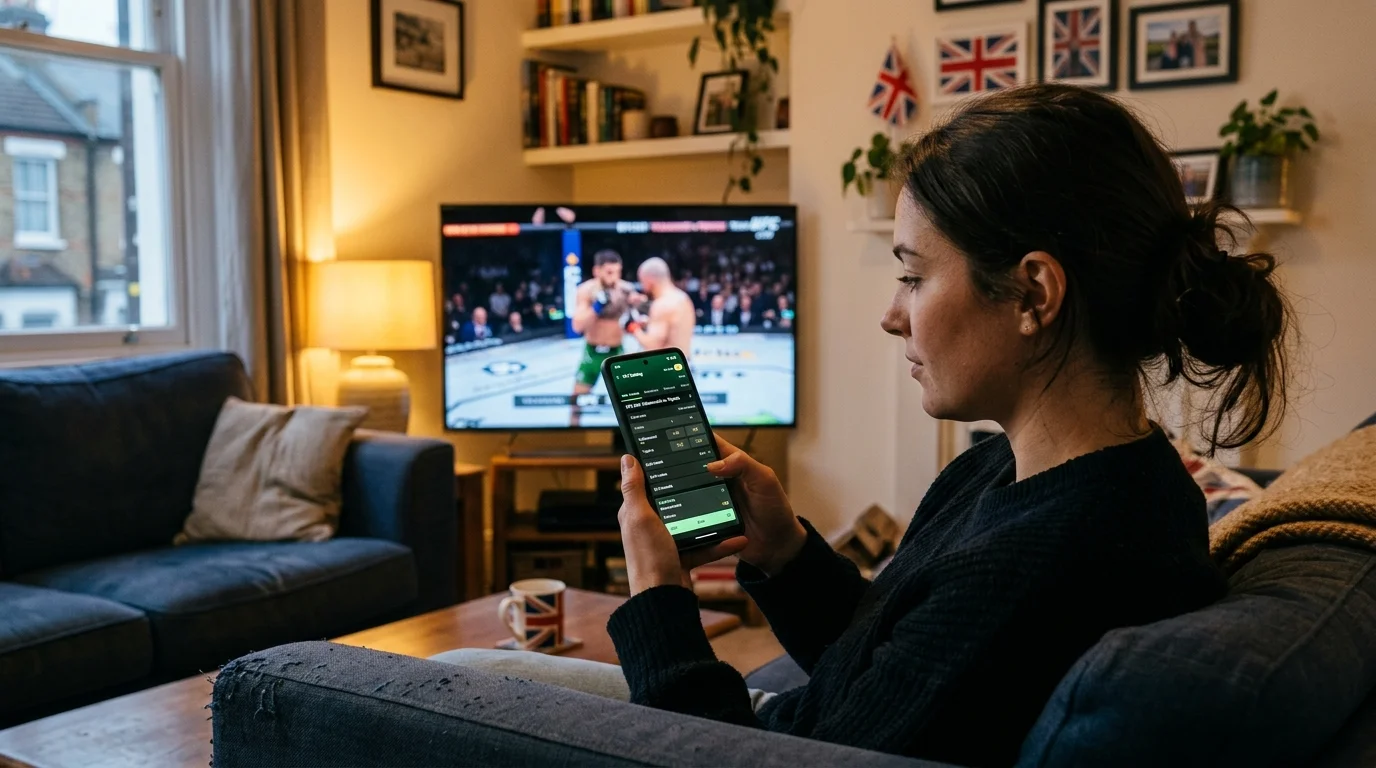
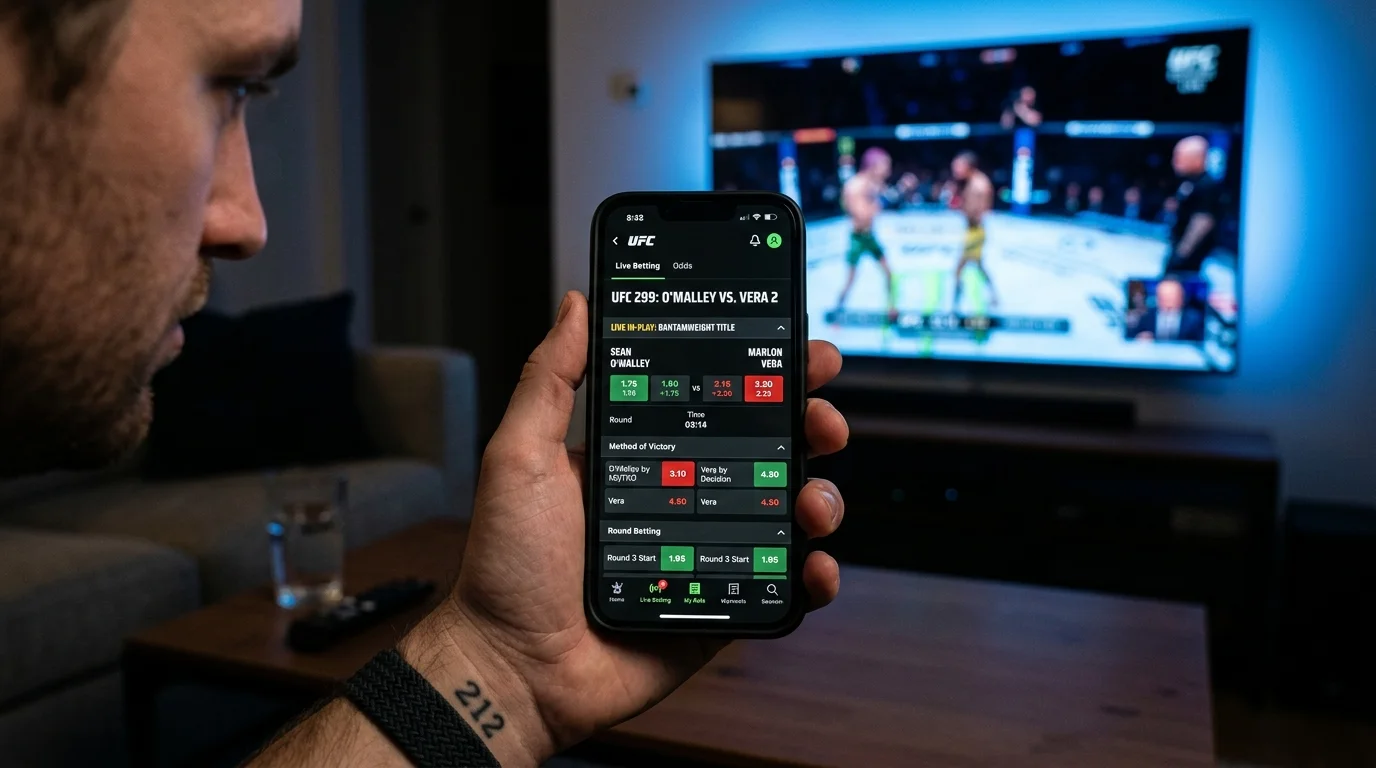
I placed my first live UFC bet during a fight that had already been going wrong for the favourite for ninety seconds. The underdog had landed a takedown, locked in a body triangle, and the favourite was burning energy trying to escape. The live odds hadn’t caught up yet — the favourite was still priced as if they were winning. I hit the underdog’s moneyline, and thirty seconds later a rear-naked choke ended the fight. That’s when I understood what live betting actually is: a market that rewards people who can read a fight faster than an algorithm can.
More than a quarter of online gamblers in the UK place in-play bets, with the highest participation among the 25-34 age group. At some major sportsbooks, in-play wagering accounts for over three-quarters of total betting turnover. Those numbers are even more pronounced for UFC, where the sport’s structure — discrete rounds, dramatic momentum shifts, visible damage — creates a natural rhythm for live bet placement.
Live UFC betting is growing faster than pre-fight markets because it offers something pre-fight bets can’t: the ability to act on information that didn’t exist when the odds were set. A fighter who looks sluggish in the first round. A cut that changes the fight’s trajectory. A grappler who reveals a surprising willingness to stand and trade. These mid-fight developments create pricing inefficiencies that evaporate within seconds — and punters who can identify them fast enough capture value that pre-fight analysis can never reach.
Dana White put it directly when the UFC Event Centre launched: the promotion has the most passionate, dedicated fans of any sport, and they want the option to place bets live during a fight. The commercial infrastructure now exists to serve that demand at extraordinary speed. Understanding how to use it — without letting the pace overwhelm your judgment — is the subject of this guide.
See also: bet on ufc fights for a complete guide to UFC wagering.
How In-Play UFC Betting Works: From Bell to Bell
Picture this: two fighters touch gloves, the referee steps back, and the opening bell rings. At that exact moment, the pre-fight odds you saw become yesterday’s news. A new set of prices — constantly updating, reacting to every significant strike, every clinch attempt, every shift in ring positioning — takes over. That’s in-play betting, and the mechanics behind it are both simpler and more complex than most punters realise.
The UFC Event Centre, built by IMG Arena, is the engine that drives live UFC odds. It delivers over 50 discrete statistics during every fight, with data updates arriving in less than two seconds. Significant strikes landed, takedown attempts, control time, distance strikes versus clinch strikes — all of it is captured in near real-time and fed directly to the sportsbooks’ pricing algorithms. The odds you see on your screen between rounds aren’t the product of a human oddsmaker watching the fight and guessing. They’re the output of automated models processing thousands of data points per minute.
Live UFC betting operates in two modes. Between rounds, the market opens fully — you can place moneyline bets, method-of-victory bets, and various props with standard processing speeds. The round break is your window for deliberate analysis and considered bet placement. During the round itself, the market is more restricted. Many sportsbooks suspend betting during active exchanges and reopen it during pauses in action. Some offer continuous live odds on select markets (like next-round winner) but with tighter limits and wider margins.
The practical experience of live UFC betting varies enormously depending on your device, your connection speed, and your sportsbook’s latency. A two-second delay between what you see on screen and what the sportsbook’s data feed reflects can mean the difference between capturing value and placing a bet that’s already been priced out. This is why mobile connectivity and app performance matter more for live UFC betting than for any pre-fight wager. I’ve found that a wired broadband connection with a desktop interface gives me roughly a one-second advantage over 4G mobile — and in a market that moves as fast as in-play UFC, one second is significant.
Between-round windows are the most accessible entry point for live UFC bettors. You have sixty seconds between rounds in a standard three-round fight and the same between championship rounds. During that minute, the market fully reopens, the pricing reflects the completed round’s action, and you have time to assess what you’ve seen against what the odds are telling you. Fighters who dominated a round will see their odds shorten; fighters who absorbed damage or lost position will drift. Your job is to evaluate whether the price movement accurately reflects the fight state or whether it’s over- or under-correcting.
One critical detail: not all sportsbooks offer the same live UFC markets. Some provide only live moneyline. Others offer live method of victory, live over/under rounds, and even live prop markets on strikes and takedowns. Before fight night, check what your sportsbook actually makes available for in-play UFC betting — discovering the limitations mid-fight, when a position you want to take isn’t available, is frustrating and avoidable.
The emotional architecture of live UFC betting is also worth understanding before you start. Pre-fight bets are placed in a calm analytical state. Live bets are placed while your heart rate is elevated, while you’re processing visual information, and while the dopamine of watching combat is active in your brain. This isn’t a minor consideration. The same punter who applies rigorous analysis to a pre-fight position will sometimes place an in-play bet based on nothing more than an exciting exchange they just watched. The information environment and the emotional environment during a live fight are working against disciplined decision-making unless you’ve built habits that separate watching from betting.
Micro-Markets Explained: Strikes, Takedowns, and Real-Time Props
Two years ago, “total significant strikes over/under 85.5” would have been an exotic curiosity at UK sportsbooks. Today, it’s a standard offering on marquee UFC fights at several UKGC-licensed platforms. The expansion of micro-markets — granular, statistic-level propositions available during or between rounds — has fundamentally changed what live UFC betting can look like.
Sportradar’s expanded partnership with operators now delivers official UFC data for in-play micro-markets covering strikes, takedowns, and other fight-level metrics with real-time updates. Eduard Blonk, Sportradar’s Chief Commercial Officer, has described how this newly acquired UFC content helps operators create more dynamic in-play betting opportunities and deepen fan engagement. The data infrastructure is there; the markets are catching up.
The most common micro-markets available during UFC events fall into several categories. Total fight strikes (over/under) asks whether the combined significant strikes across both fighters will exceed a set line. This market rewards punters who can quickly assess pace — a first round with heavy output suggests the over; a cautious, low-volume opener suggests the under. Individual fighter strikes (over/under a set number) lets you bet on one fighter’s output specifically, which is useful when you’ve identified a pace mismatch.
Takedown markets are newer and less efficiently priced. Will there be a takedown in round two? Will Fighter A attempt more than 2.5 takedowns? These markets are directly influenced by fight dynamics that unfold in real time. A striker who’s getting tagged on the feet often switches to wrestling in the next round. A grappler who gets stuffed on three takedown attempts may abandon the approach. If you’re watching closely and the algorithm is slower to adjust, there’s a window.
On DraftKings and FanDuel platforms, UFC events generate 11% of all live-bet clicks on fight days — a remarkable share for a sport that isn’t among the traditional big four. That volume means the micro-market ecosystem is commercially viable and expanding. Every major UFC event now features a broader selection of real-time props than the last, and the trend is toward more granularity, not less.
The challenge with micro-markets is information overload. Tracking five or six simultaneous live markets while watching the fight, assessing your positions, and making decisions under time pressure is cognitively demanding. I limit myself to one or two micro-market positions per fight, chosen before the event based on matchup analysis. The takedown over/under if one fighter is a credentialed wrestler facing someone with poor takedown defence. The total strikes over if both fighters are high-output pressure fighters. Having a pre-fight thesis about which micro-market offers value prevents the scatter-shot approach that leads to sloppy live betting.
There’s also a structural consideration. Micro-markets on UFC events are priced using much smaller datasets than traditional moneyline or over/under markets. A total-strikes model might be calibrated on a few hundred relevant bouts, whereas the moneyline reflects thousands of data points across comparable matchups. Smaller datasets mean wider confidence intervals around the “true” price, which in turn means more opportunities for mispricing — but also more opportunities to be wrong in your own assessment. The edge in micro-markets isn’t about being right more often; it’s about identifying the specific spots where the limited data creates a clear gap between the model’s output and the fight’s likely reality.
In-Play Round Bets: Timing Your Wagers as the Fight Unfolds
There’s a moment in almost every UFC fight where the round-by-round betting market misprices the next five minutes. Usually it comes after a dominant round — the winner’s odds for the next round compress too far because the algorithm extrapolates recent momentum, but the actual probability of a similar performance drops. Fighters adjust between rounds. Corners change gameplans. The fighter who was getting outstruck in round one switches to wrestling in round two. The market’s memory is shorter than the fight’s reality.
In-play round betting is distinct from pre-fight round betting. Pre-fight, you’re predicting the overall shape of a fight before it starts — will it end in round one, round two, or go to decision. In-play, you’re making assessments round by round as new information emerges. The two disciplines use different data and different decision frameworks, and conflating them is a common error. For the comprehensive breakdown of pre-fight round markets, including over/under, exact round, and group round bets, I’ve put together a detailed guide to UFC round betting that covers the structural mechanics.
Roughly 41% of men’s UFC bouts finish inside 2.5 rounds. That means the majority of fights go past the halfway mark of a standard three-round bout. For in-play round bettors, this has a practical implication: if you’re watching a fight that’s reached the second round without a finish, the probability of a decision has already increased beyond the pre-fight baseline. The live over/under line should reflect this, and sometimes it does. But not always quickly enough.
The timing of your in-play round bet matters as much as the selection. Placing a bet on the over during the first minute of round one, when both fighters are fresh and feeling each other out, captures a price that still reflects the pre-fight finish probability. Waiting until after a cautious, low-activity first round to place the same over bet means you’re paying a shorter price for information the market has already absorbed. The optimal window for most in-play round bets is between rounds, when you’ve seen enough to form an opinion but the pricing hasn’t fully adjusted to what you’ve observed.
Championship five-round fights behave differently from three-round bouts for live round betting. The additional rounds create more betting windows and more opportunities for the fight to change direction. A fighter who loses the first two rounds of a five-round fight is priced as a heavy underdog, but the comeback rate in championship rounds is higher than casual intuition suggests — championship fighters are selected for durability and late-fight cardio. I’ve had some of my best live round betting results on championship underdogs after two rounds, precisely because the market overweights recent performance and underweights the structural advantage of having three rounds remaining.
Which UK Bookmakers Offer the Best Live UFC Experience
Not all UKGC-licensed sportsbooks treat live UFC betting with the same level of commitment, and the differences become obvious the moment a fight starts. Some platforms offer continuous live odds with a broad range of markets. Others suspend their UFC odds for the duration of each round and reopen only during the breaks, effectively reducing your live betting to four or five sixty-second windows per fight.
In March 2026, bet365 replaced DraftKings as the UFC’s Official Sports Betting Partner for the US and Canadian markets. Trip Stoddard, bet365’s Head of Development, described UFC’s always-on event calendar and highly engaged global fanbase as a powerful environment for real-time betting — and that investment in the UFC relationship signals where the company is directing its in-play product development. For UK punters, the implication is clear: platforms that invest heavily in UFC partnerships tend to offer deeper live markets, faster odds updates, and broader micro-market coverage than those that treat MMA as an afterthought alongside football and horse racing.
When evaluating sportsbooks for live UFC betting, I look at four things. First, market availability during rounds versus only between rounds. Second, the latency between an on-screen event and the odds adjustment — faster platforms give you a larger window to act on what you’ve seen. Third, the range of live markets beyond the basic moneyline. Fourth, the stake limits on live UFC bets, which are often significantly lower than pre-fight limits and vary widely between operators.
The UFC runs 43 live events per year — 13 numbered pay-per-view events and 30 Fight Night cards. That’s nearly one event per week for most of the year, with no off-season. For live bettors, this frequency is both an opportunity and a discipline test. There’s always another fight coming, which means there’s always another chance to bet. The sportsbooks that serve UFC live betting best are the ones that make this frequency manageable — with clean interfaces, reliable notifications, and markets that open promptly rather than lagging behind the action.
Managing Risk in Fast-Moving UFC In-Play Markets
The speed of live UFC betting is what makes it exhilarating — and what makes it dangerous. I’ve watched punters with solid pre-fight analysis blow their entire card’s profit on impulsive in-play bets placed during the adrenaline of a dramatic round. The risk management framework for live UFC betting needs to account for both the analytical dimension (is this a good bet?) and the psychological dimension (am I in a state to make good decisions right now?).
My approach to live UFC risk management has three rules. First, set a live betting budget before the event that’s separate from your pre-fight stakes. I allocate no more than 30% of my total card budget to live positions. If I use it, I’m done with live betting for the night. If I don’t find value, the money stays in my bankroll. This prevents the common pattern of escalating live stakes to recover pre-fight losses.
Second, define your live thesis before the fight starts. “If Fighter A gets taken down in round one, I’ll bet the over” is a specific, pre-committed thesis. “I’ll see what happens and react” is not a thesis — it’s a recipe for emotional betting. Having a pre-defined scenario that triggers your live bet means you’re acting on analysis rather than reacting to stimulus.
Third, accept the latency. By the time you see a knockdown, process it, open your betting app, and place a wager, the odds have already moved. Chasing the exact moment of a fight-changing event is a losing proposition for any punter without professional-grade infrastructure. Instead, look for the overreaction after the event. The odds often overshoot in the immediate aftermath of a dramatic moment and partially correct in the next thirty to sixty seconds. That correction window is where retail live bettors can find realistic entry points.
Live UFC betting rewards preparation and punishes impulsiveness. If you take one thing from this guide, make it this: the same fight can be both a great entertainment experience and a terrible betting environment if you haven’t done the pre-fight work. The best live bettors I know spend more time preparing for live opportunities during fight week than they spend actually placing live bets on fight night.
See also: fair play matters in live markets — read about UFC betting integrity.
Questions About Live UFC Betting
Can I cash out a live UFC bet between rounds?
Some UKGC-licensed sportsbooks offer cash-out on live UFC bets, but availability varies by operator and by market. Cash-out is most commonly available on the live moneyline and is typically suspended during active rounds, reopening only in the between-round break. The cash-out value will reflect the current live odds, so a bet that’s moved in your favour will offer a profit, while one that’s gone against you will return less than your original stake.
How quickly do UFC in-play odds update during a fight?
The UFC Event Centre delivers data updates in under two seconds, and the best sportsbooks process this data into odds adjustments within a similar timeframe. In practice, odds between rounds update almost instantly at the end of a round, while mid-round updates happen during natural pauses in action. The gap between what you see on your broadcast and what the sportsbook’s data feed reflects can be one to three seconds depending on your broadcast delay.
What live UFC micro-markets are available at UK bookmakers?
The most common live micro-markets include total fight strikes over/under, individual fighter significant strikes, takedown attempts, next-round winner, and method of victory updated after each round. Availability varies by sportsbook and by fight — headline bouts on numbered events typically offer the widest range of live markets, while preliminary card fights may have only the live moneyline available.
Is live UFC betting riskier than pre-fight wagering?
Live betting carries higher variance because decisions are made under time pressure with incomplete information, and the bookmaker’s margins on live markets are typically wider than on pre-fight lines. The speed of the market also means mistakes are harder to recover from. However, live betting also offers unique value opportunities that don’t exist pre-fight — the risk is higher, but so is the potential reward for bettors with strong fight-reading skills.
Prepared by the bet on ufc Fights editorial staff.