UFC Betting Line Movement: Reading Sharp Money, Public Money, and Steam Moves
 Available in US
The Line Tells a Story — If You Know How to Read It
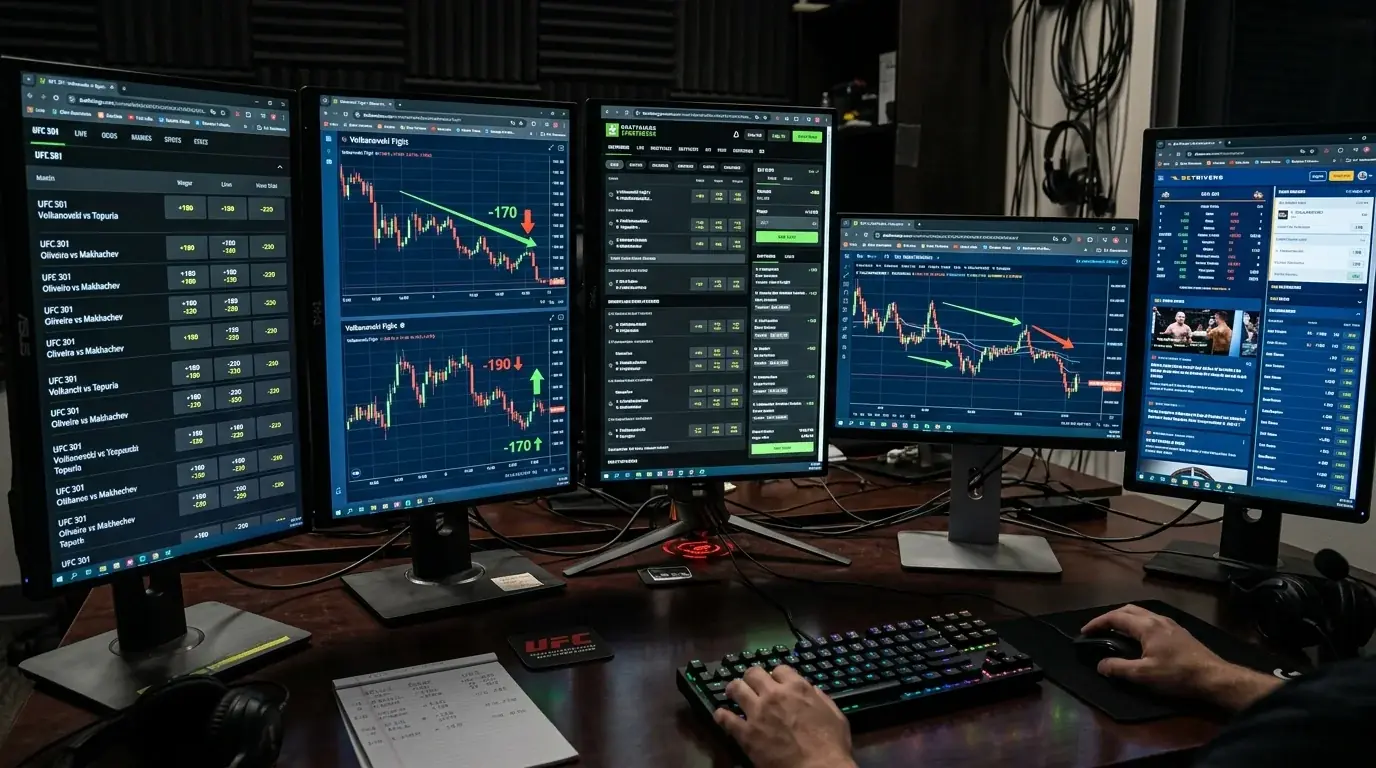
I remember the moment line movement stopped being abstract and became a concrete betting tool. A UFC lightweight was priced at -135 on Monday. By Thursday, the line had shifted to -180 — with no injury news, no public buzz, and no change in the visible circumstances of the fight. What moved was not public money. Public money on a midweek Fight Night prelim is negligible. What moved was sharp money — professional bettors with access to information or analysis that the opening line had not incorporated. I followed the steam and backed the fighter. He won convincingly. The sharp money had been right about something the rest of us missed.
Line movement in UFC is one of the most underused analytical tools available to UK bettors. The odds you see on Monday are not the odds you will see on Saturday. They shift, sometimes dramatically, between the line opening and the fight starting. Understanding why they move — whether the movement is driven by sharp action, public money, or external information — tells you something valuable about where the informed money is landing.
See also: bet on ufc fights for line shopping and timing strategies.
How UFC Lines Open and Where They Come From
Opening lines for UFC events are typically posted early in the week of the fight, sometimes as early as the previous weekend for PPV events. These lines are set by the sportsbook’s trading team using a combination of algorithmic models, historical data, and market-making expertise. The opening line reflects the bookmaker’s initial assessment of each fighter’s probability, plus their built-in margin.
In the UFC market, opening lines tend to be less accurate than in more mature betting markets like football or horse racing. The reasons are structural: MMA has less historical data, fighter performance is more variable, and the public’s pricing input (which helps refine football lines through massive volume) is thinner for most UFC fights. The 517 bouts across 42 events in 2024 sounds like a lot, but compared to the thousands of football matches priced each week, the UFC is a niche market. That relative thinness creates more pricing errors at opening — and more opportunities for bettors who track line movement.
Sharp Money vs Public Money: Identifying What Moved the Line
Not all line movement is equal. Sharp money moves lines efficiently — it pushes the odds toward the true probability. Public money moves lines noisily — it pushes the odds based on name recognition, hype, and casual analysis that may or may not be correct.
Sharp-money movement is characterised by: large line shifts on low-volume events (a prelim fight moving significantly despite minimal public attention), reverse line movement (the line moves toward the side receiving fewer total bets, because the few bets on that side are large and from respected accounts), and concentrated timing (the movement happens in a short window, suggesting a single or small group of sharp bettors entering the market).
Public-money movement looks different: gradual shifts throughout the week as casual bettors place wagers, movement toward the more popular or recognisable fighter, and stronger movement on main-event fights than on prelim bouts. Public money is not always wrong — the public picks the winner more often than not, because favourites win most UFC fights. But public money is unsophisticated about the price. A fighter can be the correct pick and still be a bad bet if the public has driven the price past fair value.
The tool I use to distinguish the two is reverse line movement. When 70% of bets are on fighter A but the line moves toward fighter B, the money on fighter B is disproportionately large — sharp bets from accounts the bookmaker respects. That signal is one of the most reliable in UFC betting, and it requires no analytical skill beyond checking the bet percentage and the line direction. Several free online tools report both for UFC events.
Steam Moves: When the Line Shifts Suddenly
A steam move is a rapid, significant line shift caused by a coordinated burst of sharp action. In UFC, steam moves are most common on Wednesday or Thursday — after lines have been open long enough for sharps to complete their analysis but before the public betting volume peaks on Friday and Saturday.
When I see a steam move, my first step is to check for news. A significant line shift can reflect information the market has just received: an injury reported by a journalist, a viral training camp video showing a fighter looking unwell, or a confirmed coaching change. If the steam move aligns with verifiable news, the movement is informational — the line is adjusting to a new reality, and following it may or may not offer value depending on how much adjustment remains.
If the steam move has no accompanying news, it is analytical — sharp bettors have found an edge that the rest of the market has not. These are the steam moves I am most interested in, because they suggest a disagreement between the sharps’ models and the opening line that is not driven by public information. Following these moves has been profitable for me over multi-year samples, though not without losing streaks. Sharps are right more often than they are wrong, but they are not right every time.
Practical Line Shopping: Using Movement to Find Best Price
Line movement creates price discrepancies across sportsbooks. When a line moves at one operator but not at another, the slower operator is temporarily offering a stale price that may represent value. This is the practical application of line-movement tracking: identifying which sportsbook has not yet adjusted to the market’s latest information.
UK bettors with accounts at multiple UKGC-licensed operators can exploit these discrepancies legally and routinely. The process is simple: check the odds across three or four operators, identify which one has the most favourable price, and place your bet there. The price difference is often 5-10% in implied probability terms — a meaningful edge that costs nothing to capture.
I check odds at a minimum of three operators before every UFC bet. The time investment is under two minutes per fight, and the cumulative value over a year of betting is substantial. Across 13.5 million monthly active online betting accounts in the UK, the majority use a single operator for convenience. That convenience costs them money on every bet. Using multiple accounts for price comparison is the single easiest improvement any bettor can make, and line-movement tracking tells you when the discrepancies are largest.
Knowing When to Bet Early and When to Wait
The timing of your bet matters as much as the selection itself. Bet too early and you risk getting a line that has not yet adjusted to sharp information. Bet too late and the value has been squeezed out by the market’s self-correcting mechanism.
See also: lock in profits mid-fight with our UFC cash out betting guide.
My general rules: for fights where I expect sharp money to favour my selection, I bet early — before the line moves against me. For fights where the public is likely to push the line in my favour (creating better value on the other side), I wait until closer to fight time. And for fights with no clear expectation of movement, I bet at whatever point my analysis is complete and the current price clears my value threshold.
The skill is in predicting the direction of movement, which comes from tracking lines across multiple events and building pattern recognition. After a few months of active tracking, you start to recognise which types of fights attract sharp action and which attract public money. That meta-knowledge — knowing how the market will behave before it behaves — is the highest-level application of line-movement analysis and one of the few genuine edges that do not require sport-specific expertise to develop. For the broader framework connecting line analysis to bet selection and staking, the UFC betting strategy guide ties these elements together.
What is reverse line movement in UFC betting?
Reverse line movement occurs when the betting line moves toward the side receiving fewer total bets. For example, if 70% of bets are on fighter A but the line moves toward fighter B, it means the money on fighter B is disproportionately large — typically from sharp, professional bettors whose accounts the bookmaker respects. This signal suggests the informed money disagrees with the public consensus.
When do UFC betting lines usually move the most?
The largest movements typically occur between Wednesday and Thursday, when sharp bettors enter the market after completing their analysis. A secondary movement window occurs on Friday after the weigh-in, when weight-cut information and fighter condition become visible. The final adjustments happen in the hours before the fight starts on Saturday, driven by late public money and any last-minute news.
Published by the bet on ufc Fights team.