UFC Betting Exchanges vs Bookmakers: How Peer-to-Peer Markets Compare for MMA Wagering
 Available in US
Two Different Engines Running on the Same Sport
For the first five years of my UFC betting career, I used traditional sportsbooks exclusively. Then a friend showed me his exchange account and the penny dropped — the odds on the same fight were meaningfully different, the margin was lower, and I could lay fighters rather than just back them. It was like discovering a second market for the same product at a better price. Exchanges are not for every bettor, but for anyone who takes UFC wagering analytically, understanding both platforms is a genuine edge.
UK remote betting generated 2.6 billion pounds in gross gaming yield during the 2024-25 financial year, with most of that flowing through traditional sportsbooks. Exchanges capture a smaller share of the overall handle but attract a disproportionate percentage of sharp money — bettors who are price-sensitive, analytical, and willing to accept a different user experience in exchange for better odds. If you already have a solid grasp of how odds work and want to understand the mechanics deeper, the odds explained guide covers the mathematical foundations that apply to both platforms.
See also: bet on ufc fights for exchange and bookmaker comparisons.
How Exchanges Work — and Why the Odds Are Different
A traditional sportsbook sets odds, takes your bet, and profits from the built-in margin. The bookmaker is your counterparty: when you win, they pay you; when you lose, they keep your stake. The overround — the margin built into the odds — typically runs 5-8% on UFC moneyline markets and higher on props.
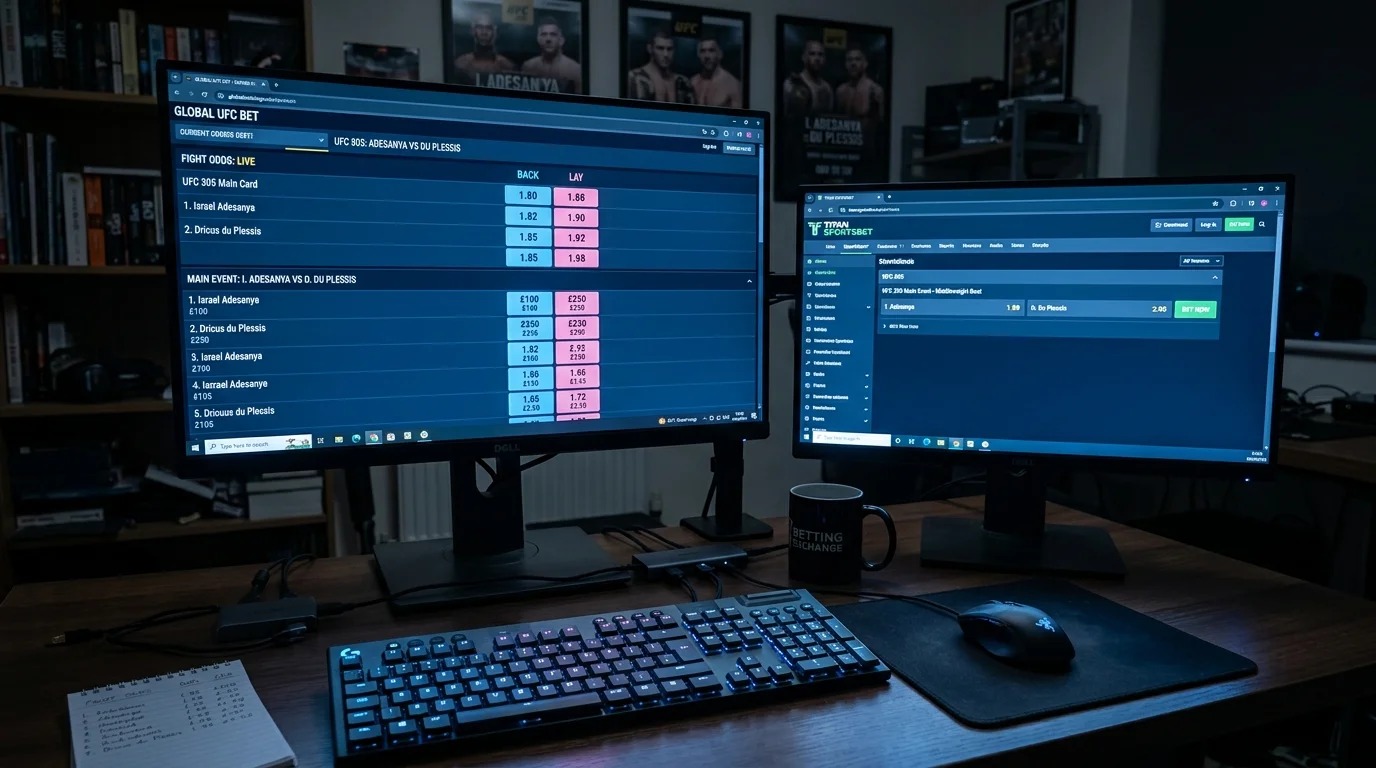
An exchange operates differently. It is a platform where bettors bet against each other. You can back a fighter (bet that they win) or lay a fighter (bet that they lose). Another bettor on the other side takes the opposite position. The exchange facilitates the match and takes a commission on the winning side, typically 2-5% of net profit. The exchange itself holds no position on the outcome.
The practical result is tighter odds. Because there is no overround built into the price — only the commission on winnings — the implied probabilities on an exchange typically sum to closer to 100% compared to 105-108% at a sportsbook. On a UFC fight where the sportsbook offers -180/+150, the exchange might show -165/+165 equivalent. That difference in price compounds across hundreds of bets over a season into a meaningful return improvement.
Laying Fighters: The Bet Type Sportsbooks Do Not Offer
The ability to lay a fighter — to bet that they lose, effectively acting as the bookmaker — is the exchange’s most distinctive feature. At a traditional sportsbook, if you believe Fighter A will lose, you back Fighter B. On an exchange, you can lay Fighter A directly. The distinction matters when the two sides of the market are priced differently, or when you have a strong opinion that one fighter will lose without a correspondingly strong opinion about who specifically will beat them.
Laying is particularly useful in UFC for two scenarios. First, when a favourite is overvalued. If Fighter A is priced at 1.40 on the exchange and you believe their true probability of winning is only 60% (fair price 1.67), laying at 1.40 gives you a positive expected value position without needing to identify which underdog will actually pull off the upset. Second, in multi-fighter events — though rare in UFC — where the method of upset matters less than the fact of one. On any given UFC card, at least two or three favourites lose. Laying the most overpriced favourite is a strategy that does not exist on traditional sportsbooks.
The risk of laying is the inverse of backing. When you lay a fighter at 1.40, you are offering odds of 1.40 to the backer. If the fighter wins, you owe the backer their profit — 0.40 units per unit they staked. Your maximum loss is the “liability” shown on the exchange bet slip, and you must have that amount available in your account when the bet is placed. Understanding liability calculations before placing lay bets is non-negotiable: one misread liability figure can blow your evening’s bankroll in a single fight.
Liquidity: The Exchange’s Achilles Heel for UFC
The biggest drawback of exchange betting for UFC is liquidity — the amount of money available to be matched on each side of a market. Football matches at major exchanges attract millions in matched bets. UFC fights, even main events, attract significantly less. The result: wider spreads between back and lay prices, slower matching of bets, and sometimes the inability to place a bet at all because nobody is on the other side at your desired price.
On numbered UFC events — the big PPV cards — exchange liquidity is reasonable for the main card fights. I can usually get matched on a moneyline position at competitive prices for the top five or six fights. On Fight Night cards and preliminary bouts, liquidity drops sharply. I have had bets sit unmatched for hours on prelim fighters, eventually expiring when no counterparty appeared. If your betting focuses on lower-profile fights, the exchange may not be viable as your primary platform.
The average active UK betting account generated roughly 107 pounds per month in gross gaming yield for operators during Q1 2025. Exchange users tend to fall above that average in wagering volume, which partially explains why the UFC exchange market is thinner than football or horse racing — the UFC exchange betting population is smaller, and the per-fight liquidity reflects that smaller pool.
When to Use Each Platform
My approach after nine years is to use both platforms based on where the better price sits for each specific bet. For main card moneyline bets on numbered events, I check the exchange first. If the exchange price beats the best sportsbook price after commission, I use the exchange. If the sportsbook is offering a promotional price or the exchange liquidity is too thin, I use the sportsbook.
For prop bets — method of victory, over/under rounds, fight goes the distance — I almost always use traditional sportsbooks. Exchange prop markets for UFC are too illiquid for consistent use. The prices might look better in theory, but if you cannot get matched, the better price is academic.
For live betting, exchanges have a structural advantage: the in-play commission model means you are not fighting against a widening sportsbook margin during volatile moments. But in practice, exchange live markets for UFC are thin and slow-updating compared to sportsbook in-play platforms. I use sportsbook live betting for speed and exchange live betting only when I have a strong opinion and the patience to wait for a match.
For laying — betting against a fighter — the exchange is the only option. If your analytical process regularly identifies overvalued favourites, having an exchange account is essential. It opens a bet type that does not exist elsewhere and converts a “pass on this fight” decision into a “lay the favourite” opportunity.
See also: explore niche markets in our UFC prop bets explained guide.
The Price Advantage Over a Season of Betting
The margin difference between exchanges and sportsbooks is small per bet — typically 2-4% on the odds — but it compounds relentlessly. Over 200 bets in a season, a 3% average price improvement translates to roughly six additional units of profit at flat staking. For a bettor wagering 20 pounds per bet, that is 120 pounds per year in pure price advantage, before any analytical edge is applied. It is not life-changing money, but it is free money that goes uncollected by any bettor who does not check exchange prices.
The mental shift is worth more than the price difference. Thinking about odds as a two-sided market rather than a take-it-or-leave-it number from the bookmaker changes how you evaluate value. You start asking “what would I need to lay this fighter at?” rather than just “do I want to back this underdog?” That bilateral thinking improves your probability estimates, sharpens your sense of fair price, and makes you a better bettor on both platforms.
What is the difference between a betting exchange and a bookmaker for UFC?
A bookmaker sets odds and acts as the counterparty to your bet, profiting from a built-in margin (overround). An exchange is a platform where bettors bet against each other, with the exchange taking a commission on winnings (typically 2-5%). Exchanges generally offer tighter odds because there is no overround, but UFC liquidity is lower than major sports like football.
Can I bet against a UFC fighter on a betting exchange?
Yes. Exchanges allow you to lay a fighter, which means betting that they will lose. This is equivalent to acting as the bookmaker for that outcome. You must have sufficient funds to cover the potential liability if the fighter wins. Laying is useful when you believe a favourite is overvalued but do not have a strong opinion on which specific opponent will win.
Prepared by the bet on ufc Fights editorial staff.