UFC Same-Game Parlays: How Bet Builders Work and When They’re Worth the Risk
 Available in US
The Appeal — and the Trap — of Combining UFC Bets
Same-game parlays are the sportsbook industry’s most effective product innovation of the past five years, and they are designed to work against you. That is not cynicism — it is maths. When you combine multiple legs from the same fight into a single bet, the bookmaker multiplies the individual odds together, but they also layer additional margin onto correlated outcomes. You pay for the thrill of a big payout, and the bookmaker takes a cut that is often invisible in the headline odds.
On DraftKings and FanDuel, UFC events generate 11% of all live-bet clicks on fight nights. A substantial share of that volume flows through parlay products. Bookmakers promote them aggressively because the effective margin is higher than on straight bets. But higher margin for the bookmaker does not mean zero value for the bettor — it means you need to be more selective, more disciplined, and more aware of how correlation affects your ticket. For a grounding in the individual prop markets that feed into parlays, the prop bets explainer covers the building blocks.
See also: bet on ufc fights for multi-bet and builder strategies.
How UFC Bet Builders Work at Major UK Sportsbooks
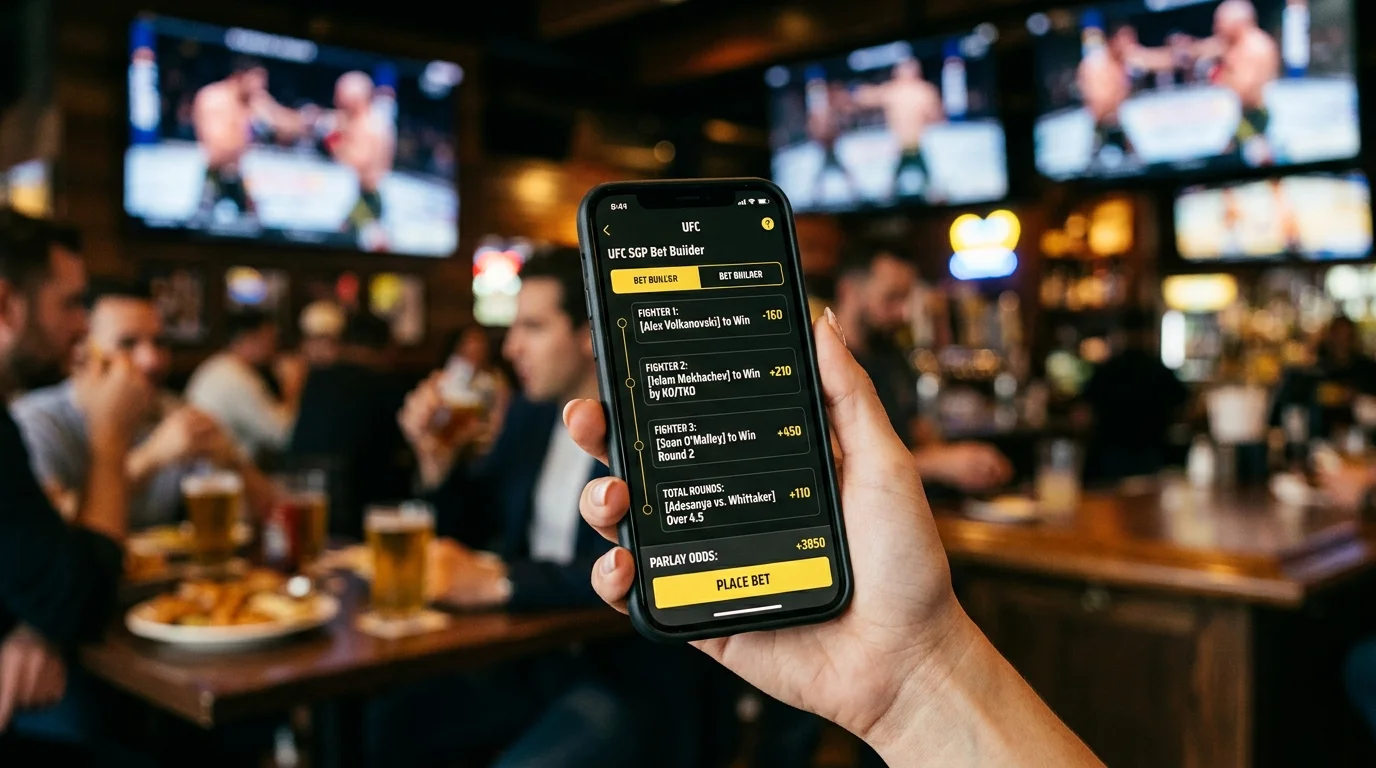
A bet builder (the UK term for what American sportsbooks call a same-game parlay) lets you combine selections from the same fight into one wager. A typical UFC bet builder might combine: fighter A to win + fight to end by KO/TKO + under 2.5 rounds. Each leg has its own odds, and the bet builder multiplies them (with adjustments) to produce a combined price.
The mechanics vary slightly by operator. Some allow two legs, others up to six. The available markets differ too — most UK sportsbooks include moneyline, method of victory, over/under rounds, and “fight goes the distance” in their UFC bet builders. Fewer include fighter-specific props like significant strikes or takedowns, though this is expanding as data feeds improve.
The critical detail that most bettors miss is the correlation adjustment. When two legs of your parlay are related — and in UFC, almost all legs within a single fight are related — the bookmaker reduces the combined odds below what you would get by multiplying the individual prices. Fighter A winning and the fight ending by KO/TKO are positively correlated if fighter A is a striker. The bookmaker knows this and prices accordingly. The problem is that the adjustment is not transparent; you cannot see exactly how much the combined price has been reduced. This opacity is where the bookmaker’s additional margin hides.
Correlated Legs: Why Some Combinations Are Restricted
Correlation is the concept that makes or breaks same-game parlays. Two outcomes are correlated when the occurrence of one changes the probability of the other. In UFC, almost everything within a single fight is correlated to some degree.
Strong positive correlations: fighter A wins + fight ends by KO/TKO (if fighter A is a knockout artist); fighter B wins + over 2.5 rounds (if fighter B is a grinder who dominates late); under 1.5 rounds + KO/TKO (most first-round finishes are knockouts, not submissions). These combinations make intuitive sense, but because they are strongly correlated, the bet builder will price them less generously than the naive multiplication of individual odds would suggest.
Weak or negative correlations: fighter A wins + over 2.5 rounds (possible if fighter A wins a decision, but negatively correlated with fighter A winning by early finish); submission + under 1.5 rounds (submissions in the first round are relatively rare). Combinations with weak correlation closer to independence offer the best mathematical value in a bet builder, because the bookmaker’s correlation adjustment is smallest when the legs are least related.
Some combinations are simply restricted by the bookmaker. You typically cannot combine “fighter A wins” with “fighter A wins by KO” because the second leg is a strict subset of the first. Other restrictions vary by operator — it is worth checking which legs your bookmaker actually allows before building a theoretical parlay that you cannot place.
Three Sample UFC Parlays: Conservative, Balanced, and Aggressive
To illustrate how different parlay constructions carry different risk profiles, here are three hypothetical builds for a fight between a strong wrestler favoured at -200 and a striker at +170.
Conservative (two legs): Wrestler wins + over 2.5 rounds. The thesis is that the wrestler controls the fight and grinds out a decision. These legs are positively correlated (wrestlers who win tend to go the distance), so the combined price will be modest — perhaps 2/1 or 5/2. The hit rate on a parlay like this is relatively high, but the payout is only marginally better than a straight moneyline bet on the wrestler. Favourites win roughly 72% of UFC bouts, and when they are wrestlers, decisions are common. This parlay captures that tendency without adding speculative legs.
Balanced (three legs): Wrestler wins + by decision + over 2.5 rounds. Adding the “by decision” method leg to the first two creates a tighter thesis: the wrestler not only wins but wins specifically on the scorecards. The odds improve — perhaps 3/1 to 4/1 — but the risk increases because you are now exposed to the wrestler winning by ground-and-pound stoppage (which would void the decision leg). This build works best when the wrestler has a history of control-oriented fights with few finishes.
Aggressive (three-plus legs): Striker wins + by KO/TKO + under 2.5 rounds. This is a pure upset-and-finish play. The odds are generous — potentially 8/1 to 12/1 — but you need the underdog to win, win by knockout, and do it early. Each additional condition compounds the improbability. I use aggressive builds only when I have a strong contrarian thesis that the market is significantly undervaluing the underdog’s finishing ability.
The key principle across all three: every leg should reinforce the same fight narrative. A parlay with conflicting legs — fighter A wins by KO but the fight goes over 2.5 rounds — is not a bet; it is a contradiction. Each leg should follow logically from the one before it.
When Parlays Make Sense — and When They Do Not
Same-game parlays make mathematical sense in exactly one situation: when the combined probability you assign to the parlay is higher than what the bookmaker’s combined odds imply, after accounting for the correlation adjustment and the additional margin. That is a high bar. In practice, it means parlays are justified far less often than the betting public uses them.
See also: card type affects liquidity — explore Fight Night vs PPV betting.
I build a same-game parlay roughly once or twice per UFC card — when a specific fight narrative is clear, the legs are logically connected, and the combined price represents genuine value. For the other ten or eleven fights on the card, straight bets are the correct play. The discipline to pass on a parlay when the value is not there is the single most important skill in using bet builders profitably.
Can I combine bets from different UFC fights into one parlay?
Yes. Standard multi-fight accumulators combine moneyline or prop selections from different fights on the same card. These are distinct from same-game parlays, which combine legs from a single fight. Multi-fight accas carry their own risk — a single upset on any fight voids the ticket — but they do not involve the same correlation-adjustment issues as same-game parlays.
Why do some UFC bet builder legs get rejected by the bookmaker?
Legs are rejected when they are logically dependent — one outcome is a subset of the other. For example, ‘fighter A wins’ and ‘fighter A wins by KO’ cannot coexist in a builder because the second is already contained within the first. Some operators also restrict combinations where the correlation is so strong that the parlay would represent very little additional risk beyond a straight bet, which defeats the product’s purpose from the bookmaker’s perspective.
Published by the bet on ufc Fights team.