UFC Live Betting Strategy: How to Bet In-Play During Fights
 Available in US
- Between-Round Windows Are Where the Real Money Moves
- Reading Momentum Shifts Before the Market Catches Up
- Between-Round Betting: The 60-Second Decision Window
- In-Round Betting: When Markets Stay Open Mid-Fight
- Live Bankroll Rules: Sizing Bets When the Clock Is Ticking
- The Pre-Fight Preparation That Makes Live Betting Profitable
Between-Round Windows Are Where the Real Money Moves
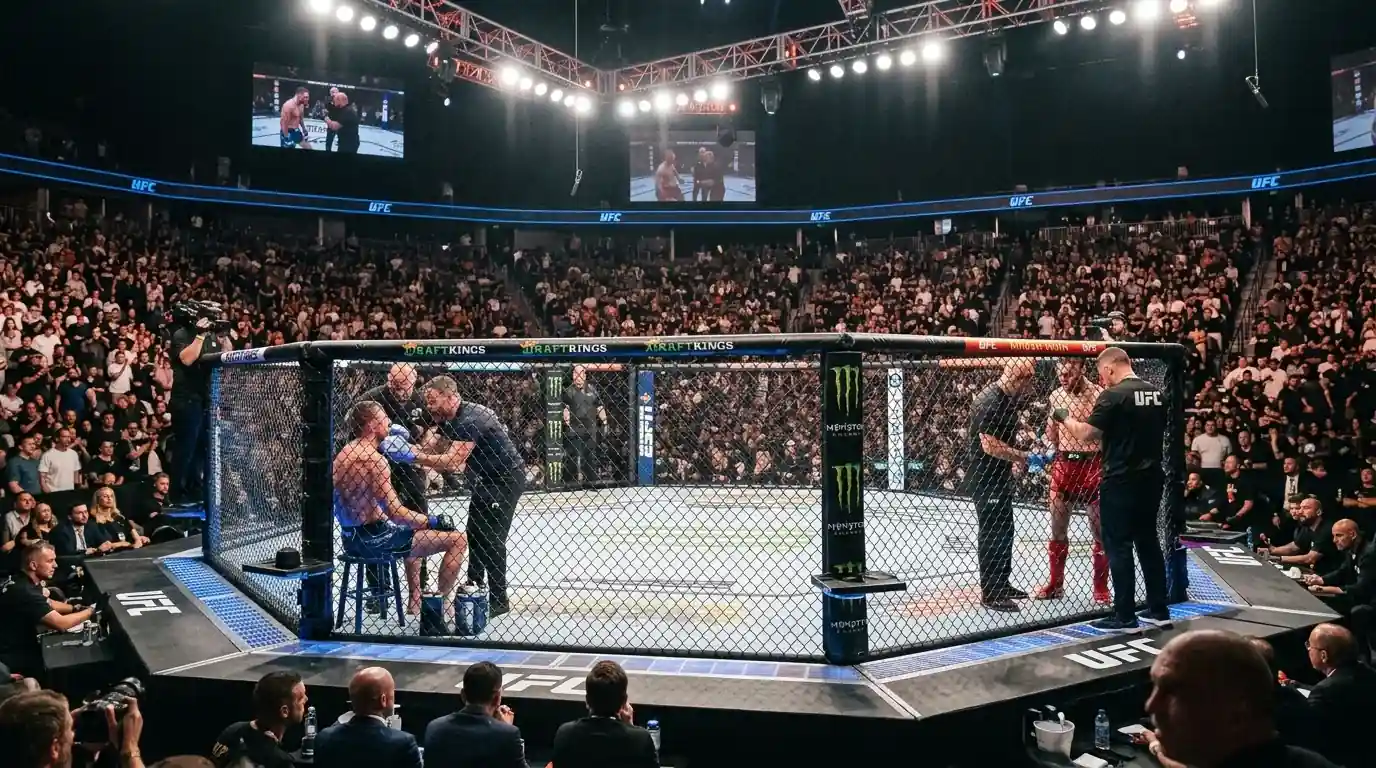
The biggest single-bet profit I have ever made came during a 60-second break between rounds two and three. The favourite had just lost the second round clearly — dropped, cut, visibly tired. The live moneyline swung from -350 to -140 in the space of that round. I backed the underdog at +120 and watched him finish the fight in the third. That swing — the market overcorrecting in real time based on a single round of action — is what makes UFC live betting uniquely profitable for anyone who knows what to look for.
On DraftKings and FanDuel, UFC events generate 11% of all live-bet clicks on fight nights. That volume reflects the sport’s suitability for in-play wagering: clear round breaks that create natural betting windows, dramatic momentum shifts that move lines, and a finish rate of 45% in 2024 that keeps outcomes uncertain deep into fights. But live betting rewards preparation, not reaction. If you are scrambling to evaluate odds after the bell rings, you are already behind. For the foundational odds mechanics that underpin live price movements, the odds explained guide covers formats and implied probability calculations.
See also: bet on ufc fights for in-play techniques and tips.
Reading Momentum Shifts Before the Market Catches Up
Live odds in UFC are set by algorithms that process official strike counts, knockdowns, takedowns, and control time in near-real-time. The Sportradar feed delivers over 50 statistics per fight to bookmakers’ pricing engines. But those algorithms have blind spots. They weight recent events heavily — a knockdown in round two causes a larger line movement than a sustained body-attack strategy that slowly saps an opponent’s cardio over three rounds.
The edge for a live bettor is recognising what the algorithm overreacts to and what it misses. A clean knockdown that did not actually hurt the fighter (they popped straight back up, stance unchanged, footwork intact) often causes the line to move further than the situation warrants. Conversely, a fighter who absorbs leg kicks round after round without visible damage will not move the algorithm’s line — but anyone who has watched enough MMA knows that accumulated leg damage collapses fighters in later rounds without warning.
I keep a mental checklist during every round: breathing rate, stance width, lead leg mobility, clinch energy, and cage-cut speed. These are the micro-signals that predict future performance more accurately than the strike counter. A fighter with a high significant-strike count but widening stance and declining punch speed is a fighter about to fade. A fighter with fewer strikes but composed footwork and efficient output is conserving energy for a late push. The algorithm sees the strike count. I see the context around it.
Between-Round Betting: The 60-Second Decision Window
Most UK sportsbooks keep UFC live markets open during the round breaks — typically a 55-to-60-second window where you can place bets at adjusted odds. This is the primary live-betting window for most punters, and it is where the majority of in-play volume concentrates.
The challenge is speed. You have roughly one minute to assess what just happened, evaluate the updated odds, decide whether to bet, and execute the bet on your app before the next round starts and markets suspend again. I prepare for this by doing my analysis during the round, not after it. By the time the bell rings, I already know whether the round unfolded as expected, whether the line movement is justified, and what price I am willing to take. The between-round window is for execution, not deliberation.
A practical workflow: before each fight, I write down my pre-fight assessment — who wins, by what method, in what round range, and at what price I would take each side. During the fight, I track whether the action matches my prediction. If round one plays out exactly as expected, there is usually no live bet to make — the market has adjusted in line with what I already anticipated. The value appears when reality diverges from the market’s expectation: when the favourite looks weaker than the odds suggest, or the underdog looks stronger.
In-Round Betting: When Markets Stay Open Mid-Fight
Some operators offer in-round betting — markets that remain open during the action, not just during breaks. These markets move fast, with odds updating every few seconds based on the live data feed. In-round betting is the most volatile and the most difficult to execute profitably.
The odds during a round react to every significant event: a landed punch, a takedown, a submission attempt. The price can swing multiple times within a single exchange on the ground. For most bettors, this volatility is a trap. The speed of price movement means you are often chasing a line that has already moved past the value point by the time you tap the confirm button on your phone.
I use in-round betting in exactly one scenario: when a fighter has been knocked down but is clearly recovering. The market panics on knockdowns — live odds for the hurt fighter spike to massive underdogs, sometimes +400 or higher, in the seconds after they hit the canvas. If I can see that the fighter is recovering well (posture returning, active defence, opponent not swarming to finish), I will snap the underdog live line before the algorithm recalibrates. This play requires fast app execution, split-second fight reading, and a willingness to be wrong — because sometimes the fighter who looks like they are recovering gets finished 10 seconds later.
Live Bankroll Rules: Sizing Bets When the Clock Is Ticking
Live betting creates unique bankroll pressures. The speed of decision-making and the emotional intensity of watching a fight while wagering on it both push you toward oversizing bets. I have stricter bankroll rules for live bets than for pre-fight wagers, and I recommend the same for anyone entering the in-play market.
My live-bet stake is capped at half my standard pre-fight stake. If my normal bet size is 20 pounds, my live bets are 10 or less. The logic is that live bets inherently carry more uncertainty — you are acting on incomplete information in real time, and the risk of emotional decision-making is higher. The smaller stake size is a structural hedge against those pressures.
I also set a maximum number of live bets per card. For a 13-fight UFC event, I allow myself three live bets at most. This forces selectivity. Without a cap, the temptation is to bet on every fight in play, which dilutes whatever edge you might have on specific matchups and guarantees exposure to fights you have not properly studied.
The 45% finish rate in 2024 means that roughly half of UFC fights end before the distance. For live bettors, this has a direct implication: a live bet placed in round one of a three-round fight has about a 55% chance of reaching the scorecards, but a live bet placed in round three of a five-round fight has a much higher chance of being resolved by decision. Adjusting your live-bet sizing and market selection based on where you are in the fight — early versus late — is a nuance that separates profitable live bettors from recreational ones.
The Pre-Fight Preparation That Makes Live Betting Profitable
The best live bets are not made during the fight. They are planned before it starts. Every profitable live-betting session I have had followed the same structure: detailed pre-fight analysis identifying specific scenarios that would create value, a clear price threshold for each scenario, and the discipline to bet only when the scenario materialised and the price exceeded the threshold.
See also: combine live picks into multi-fight bets with our UFC parlay strategy.
The worst sessions were the ones where I sat down with no plan and reacted to the action in real time. Reactive live betting is entertainment. Planned live betting is strategy. The difference in long-term results is the difference between losing slowly and grinding a genuine edge. If you treat live UFC betting as a test of preparation rather than a test of reflexes, the between-round window becomes the most valuable 60 seconds in sports betting.
Is live UFC betting available at all UK sportsbooks?
All major UKGC-licensed sportsbooks offer live in-play betting on UFC events. The range of live markets varies — some operators offer only moneyline and over/under rounds during fights, while others include method of victory, significant strike totals, and other fighter props. Market availability also depends on the profile of the fight, with main events receiving the broadest live coverage.
When is the best time to place a live bet during a UFC fight?
The between-round break — roughly 60 seconds between the end of one round and the start of the next. This is when markets are open, odds are adjusted based on the completed round, and you have a brief window to evaluate and execute. In-round betting is available at some operators but carries significantly higher risk due to rapid price movement and the difficulty of making composed decisions during live action.
Published by the bet on ufc Fights team.